A strong UCAT score is rarely the result of one frantic month during the summer holidays. The more useful question is not simply when to start UCAT preparation, but how to begin early enough to build the skills the test demands without allowing UCAT preparation to take over your A-Levels, wellbeing or wider Medicine or Dentistry application.
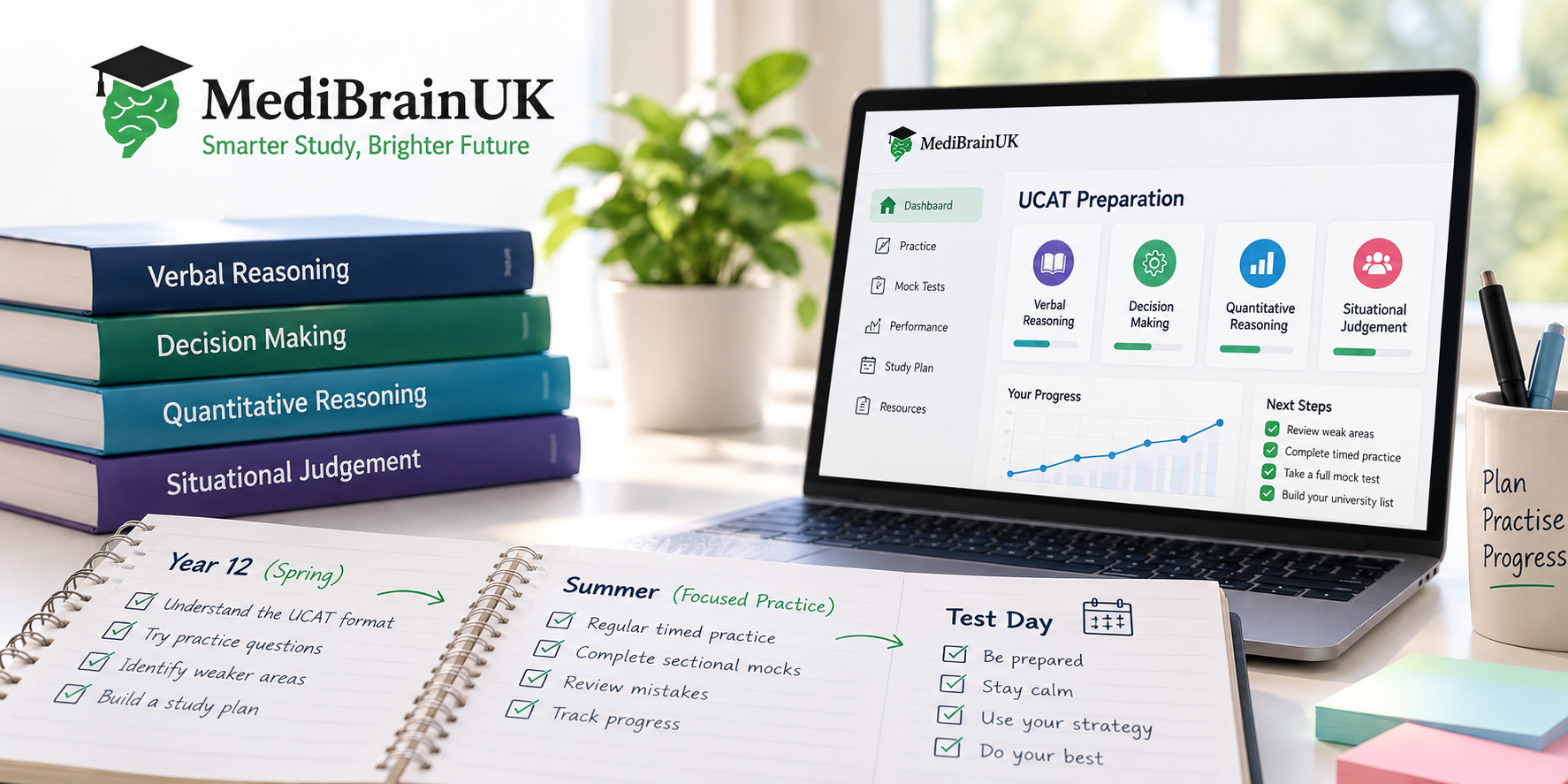
For most applicants, a sensible approach is to begin light preparation in the spring of Year 12, before moving into more focused, timed practice during the summer before Year 13. This gives you time to understand the test, establish your starting point, identify weaker areas and improve steadily before UCAS decisions begin competing for your attention.
When should you start UCAT preparation?
If you are applying directly from sixth form, March to May of Year 12 is a reasonable time to start familiarising yourself with the UCAT.
At this stage, you do not need to complete full mock examinations every weekend. In fact, doing too much too early can be counterproductive. Your first objective should be to understand what each subtest assesses, try representative questions and establish an honest baseline.
The UCAT is a speed-based aptitude test. It assesses Verbal Reasoning, Decision Making, Quantitative Reasoning and Situational Judgement under significant time pressure.
This means improvement is not simply about learning more content. Successful preparation involves developing efficient methods, recognising question patterns, making decisions under pressure and knowing when to move on from a difficult question rather than allowing it to consume valuable time.
Starting in the spring gives you a useful diagnostic period.
You may discover, for example, that Quantitative Reasoning feels relatively comfortable because of your mathematical background, while Verbal Reasoning requires much more deliberate work. Another student may understand the questions well but consistently lose marks because they spend too long trying to achieve perfect accuracy.
These are very different problems and require different preparation strategies.
It is much better to identify them in April or May than during the final week before your UCAT.
For many applicants, the more intensive preparation phase will then fall between late June and their chosen test date. Around six to eight weeks of structured preparation can work well for many students, although there is no universal timetable. Your starting point, school commitments, confidence, rate of improvement and test date should all influence the plan.
A sensible Year 12 UCAT timeline
March to May: understand the test
Start with one or two short sessions each week.
Learn the structure of the UCAT, explore the different question types and practise without becoming overly concerned about your overall score.
Keep a simple error record. When you get a question wrong, ask why:
- Did I misunderstand the question?
- Did I miss an important word?
- Was my method inefficient?
- Did I make a calculation error?
- Did I spend too long on the question?
- Did I change a correct answer unnecessarily?
This is far more useful than simply recording percentages.
June: develop reliable methods
Begin increasing the consistency of your practice.
Work on individual subtests and introduce proper timing gradually. By this stage, you should be developing methods that you can reproduce reliably rather than experimenting with a completely different technique every session.
Review is particularly important. If you complete 30 minutes of practice and never investigate why you lost marks, much of the learning opportunity has been wasted.
July and August: practise under realistic conditions
As your test approaches, timed practice should become increasingly important.
Complete sectional mocks and then full mocks once you understand the question types sufficiently well for a mock to tell you something useful.
At this stage, you are testing more than accuracy. You are developing:
- pacing;
- concentration;
- decision-making under pressure;
- stamina;
- recovery after a difficult section; and
- confidence in your established methods.
The exact timetable should remain flexible. Students with demanding end-of-year examinations may need a quieter June followed by a more concentrated July. Gap-year applicants may have more time available, but even then, starting many months in advance does not automatically produce a better result.
Quality, consistency and careful review matter more than simply starting exceptionally early.
Why starting UCAT preparation too late creates pressure
It is certainly possible to improve quickly in the UCAT, particularly if you already process numerical and written information efficiently.
However, leaving almost all your preparation until two or three weeks before the test creates unnecessary risk.
First, you have less time to discover which strategies genuinely work for you. A Decision Making technique that works extremely well for one student may slow another student down.
Second, students preparing late can easily confuse volume with progress. Completing mock after mock may feel productive, but if the same timing and reasoning mistakes continue appearing, the number of questions completed becomes almost irrelevant.
There is also a wider admissions consideration.
Your UCAT result does not exist in isolation. It eventually becomes one part of the evidence you use when deciding where to apply for Medicine or Dentistry.
Different universities use UCAT results differently. Some place considerable weight on the score when selecting applicants for interview. Others assess it alongside GCSEs or equivalent qualifications, predicted or achieved grades, contextual information and other selection criteria.
This is why UCAT preparation and university selection should not be treated as completely separate stages of the application.
From UCAT score to medical school choices
Once you receive your UCAT result, the question changes.
You are no longer asking:
“How can I improve my UCAT?”
You are asking:
“What does this score mean for my university choices?”
This is where applicants sometimes make avoidable mistakes. A score that appears disappointing compared with online discussions may still be workable for universities whose selection processes fit the applicant's wider profile. Conversely, a strong UCAT score does not automatically make every medical school a sensible choice.
The important step is to consider the whole applicant profile.
MediBrain UK's ApplySmart™ tool is designed around this principle. Rather than treating the UCAT score as a standalone number, it allows an applicant's UCAT performance to be considered alongside factors such as academic qualifications, GCSE profile, predicted or achieved grades, qualification route, contextual circumstances and relevant university entry requirements.
It can then help applicants compare medical schools according to how well their individual profile appears to fit the published selection criteria.
This is particularly useful because the same UCAT score can have a very different significance at different universities.
For example, an applicant may appear competitive academically for one medical school but face greater risk because that university places substantial weight on UCAT performance. At another university, the combination of academic attainment, contextual eligibility and UCAT performance may create a more realistic overall profile.
ApplySmart™ is therefore most useful as a decision-support tool, rather than as a promise of an interview or offer. Admissions policies, applicant numbers and competitive thresholds can change from year to year, so applicants should still check current university information carefully.
The aim is not to find a university that is “easy to get into”. It is to understand where your evidence fits the selection process most sensibly and build a balanced UCAS application.
That makes the period immediately after receiving your UCAT result particularly important. Give yourself enough time not only to sit the test, but also to interpret the result properly before finalising your university choices.
Do not begin with full mocks
One of the most common UCAT preparation mistakes is completing full mock after full mock from the beginning.
A mock is primarily an assessment tool. It tells you how you performed under a particular set of conditions. It does not automatically teach you how to improve.
Begin by understanding the demands of each subtest.
In Verbal Reasoning, practise locating evidence efficiently rather than reading every passage as though it were an A-Level essay.
In Quantitative Reasoning, concentrate on identifying relevant information and using efficient methods accurately.
For Decision Making, learn to distinguish between what is definitely supported and what merely appears plausible.
For Situational Judgement, develop your understanding of professional behaviour, patient safety, honesty, confidentiality, teamwork and appropriate escalation.
Once you have established reliable approaches, timed practice becomes much more valuable.
Take your review at least as seriously as the questions themselves.
Look for patterns. Perhaps you repeatedly lose time on percentage changes. You may second-guess straightforward inference questions, struggle to move on when uncertain or overlook important qualifiers such as “most likely” and “must be true”.
Your preparation should target the pattern behind the lost marks rather than simply repeating more questions.
How much UCAT preparation is enough?
There is no perfect number of preparation hours.
A student starting from a relatively high baseline may need less time than someone who needs to rebuild confidence in numerical reasoning or reading under pressure.
Equally, a strong baseline is not a reason to become complacent. UCAT performance depends heavily on timing, concentration and decision-making, all of which can change considerably under test conditions.
For many applicants, three to five purposeful sessions per week during the focused summer period is more useful than occasional exhausting study days.
A session does not need to last several hours.
You might spend 30 minutes completing timed Quantitative Reasoning questions, followed by a careful review of every error. On another day, you could concentrate on Verbal Reasoning with a fresh mind.
As the test approaches, introduce full mocks at sensible intervals and reproduce test conditions as closely as practical. Work somewhere quiet, follow the timing strictly and avoid checking answers midway through the test.
Afterwards, analyse your performance by both subtest and error type.
A score alone cannot tell you whether the underlying problem was technique, timing, concentration, fatigue, nerves or misunderstanding.
If your scores plateau, do not automatically respond by adding more hours.
Diagnose the problem first.
You may need a different time-management strategy, more focused drills, support with one particular subtest or simply a short reset. Disciplined adaptation is much more useful than panic practice.
Fit UCAT preparation around the rest of your application
The summer before Year 13 can become extremely busy.
Alongside UCAT preparation, you may be reflecting on work experience, preparing your UCAS application, continuing volunteering or caring commitments and managing school or personal responsibilities.
The answer is not to attempt everything every day.
Instead, give each part of the application a clear place within your week.
The UCAT deserves focused attention because it is time-sensitive and difficult to improve at the last minute. However, it should not completely replace academic work or the wider development expected of a future medical or dental student.
Universities still expect applicants to meet demanding academic requirements, while interviews will later explore qualities such as communication, judgement, motivation and your ability to reflect meaningfully on your experiences.
For students who benefit from additional structure, targeted UCAT teaching or coaching can help identify weaknesses, improve technique and provide accountability. The purpose should be to make preparation more focused—not simply to increase the number of hours spent answering questions.
Choosing the right UCAT test date
Choose a test date that gives you enough preparation time while also leaving a reasonable contingency period before your UCAS application needs to be finalised.
Avoid automatically choosing the final available date unless there is a good reason.
Illness, technical problems or unexpected personal circumstances are much easier to manage when your entire admissions timetable is not dependent on one narrow window.
There is another advantage to sitting with sufficient time remaining: your UCAT result can inform your university strategy.
Once you know your actual score and Situational Judgement result, you can compare them with your academic and contextual profile and investigate which medical or dental schools may represent sensible choices.
At the same time, do not keep postponing your test simply because you are waiting to feel completely ready.
Most applicants never reach a point where every question feels easy.
Readiness means something more practical: you have established methods, understand your pacing, know how to respond when a section becomes difficult and can produce reasonably consistent performance under realistic conditions.
Final advice: start early enough to learn, not early enough to burn out
For most Year 12 applicants, beginning light UCAT preparation in the spring and moving into focused preparation during the summer provides a sensible balance.
Starting earlier is not automatically better. Starting later is not automatically disastrous.
What matters is whether you have enough time to learn, practise, review and adapt.
And remember that the UCAT is not the final destination. Once your result arrives, it becomes part of a much bigger admissions picture involving your academic record, contextual circumstances, university selection strategy and eventually your medical school interview.
Prepare for the UCAT with that wider purpose in mind.
A calm, structured approach will not only put you in a stronger position for test day; it will also give you the time and evidence needed to make more informed decisions about where to apply.