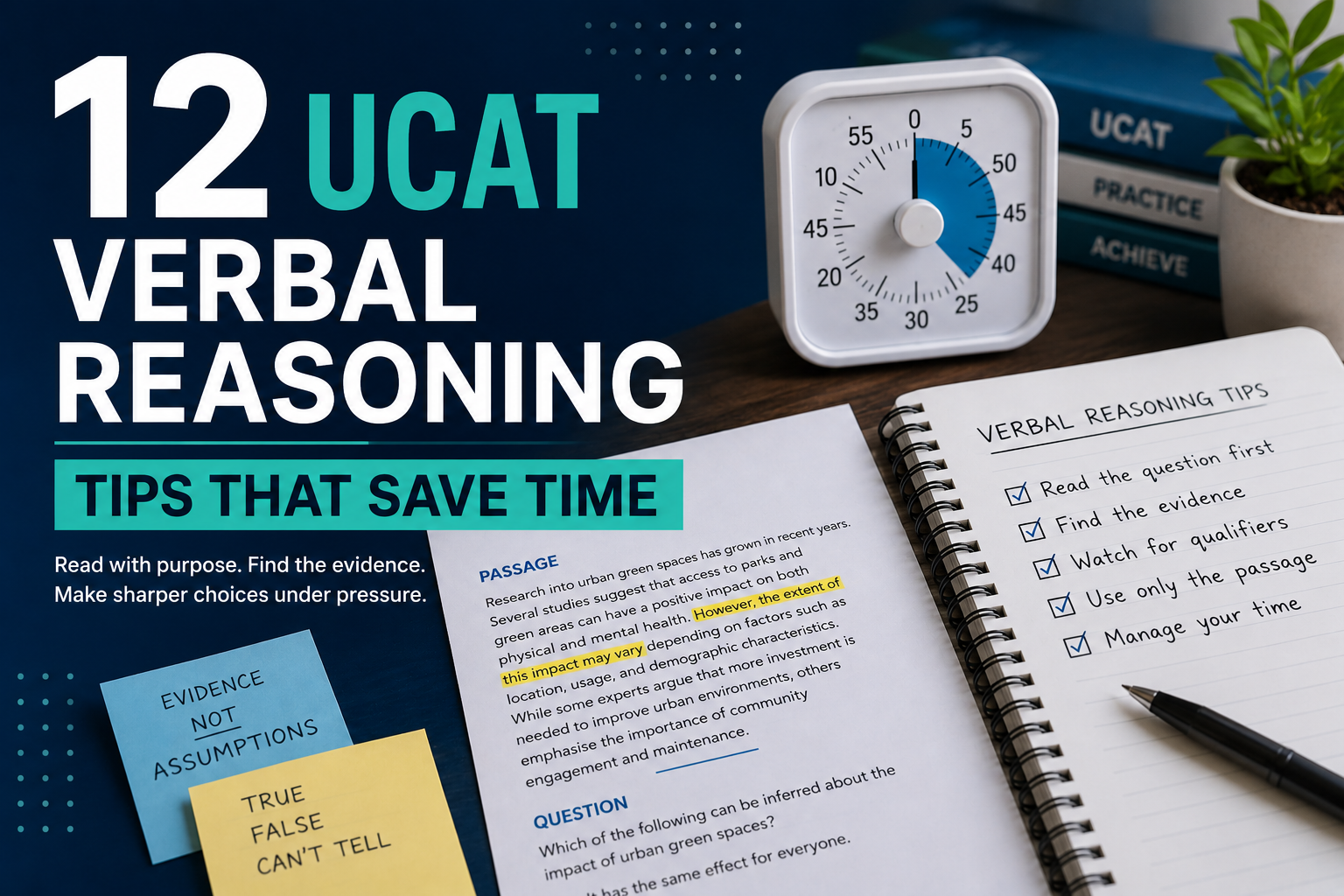
UCAT Verbal Reasoning can feel straightforward when you first look at it: read a passage, answer a question and move on. The difficulty becomes obvious once the timer starts.
With limited time to read, find evidence and make a decision, you cannot approach every passage as if you were reading an English essay. You need to know what you are looking for, recognise when you have enough evidence and move on before one difficult question eats into the rest of the section.
These 12 UCAT Verbal Reasoning tips will help you work more efficiently while keeping your answers grounded in the passage.
Why is UCAT Verbal Reasoning difficult?
Verbal Reasoning is not testing how much you know about medicine, science, history or current affairs. It is testing how accurately you can understand and use written information under time pressure.
That distinction is important.
You might read a passage about a topic you already know well. The temptation is to use that knowledge when choosing an answer. Don't. In Verbal Reasoning, the passage is your source of evidence.
If the passage does not support a statement, your outside knowledge cannot make it correct.
Timing creates another challenge. Spending extra time on a difficult question might help you get that one mark, but it could leave you rushing through several easier questions later.
The aim is therefore not to understand every passage perfectly. It is to find the evidence you need and make the best decision you can within the time available.
1. Read the question before the passage
For many Verbal Reasoning questions, start by reading the question rather than immediately reading the whole passage.
Ask yourself: What am I actually looking for?
It could be:
- a date;
- a person's opinion;
- a comparison;
- a cause;
- an advantage or disadvantage; or
- a conclusion.
Once you know what you need, you can search the passage with a purpose instead of trying to remember everything you have just read.
2. Scan for keywords — but look for synonyms too
Identify one or two distinctive words in the question and scan the passage for them.
Names, dates, numbers and unusual terms are particularly useful because they stand out.
But don't rely on finding exactly the same wording.
For example, if the question refers to an increase, the passage might use words such as rise, growth or higher instead.
UCAT questions often paraphrase information from the passage, so train yourself to recognise the same idea expressed in different ways.
3. Read around the evidence
Finding a keyword is only the beginning.
Once you locate the relevant sentence, read the sentence before and after it as well. The surrounding information may completely change its meaning.
Pay particular attention to words such as:
may, can, usually, sometimes, primarily, only, some, most and always.
These words are easy to overlook when you are rushing, but they matter.
If a passage says a treatment may improve an outcome, an answer claiming that it will always improve the outcome goes further than the evidence allows.
4. Use only information from the passage
One of the most important UCAT Verbal Reasoning rules is simple:
Don't answer from memory. Answer from evidence.
A passage may discuss something you studied at school or read about recently. That can actually make the question more difficult because you may automatically fill in information that isn't written in the text.
Before selecting an answer, ask:
Where is the evidence for this in the passage?
If you cannot find it, be careful about choosing the answer simply because it sounds sensible.
5. Watch for answers that exaggerate the passage
Incorrect answers are not always obviously wrong.
Sometimes they take something that is true in the passage and make it stronger.
For example:
- some becomes most;
- may becomes will;
- can becomes always;
- an association becomes a cause.
The answer may look familiar because it uses language from the passage, but the meaning has changed.
Read the whole claim rather than matching individual words.
6. Master True, False and Can't Tell
These questions become much easier when you use strict definitions.
True: the statement is supported by the passage.
False: the statement is contradicted by the passage.
Can't Tell: the passage does not give you enough information to decide.
A common mistake is choosing False simply because the passage does not mention something.
Missing information does not automatically mean the statement is false.
If you need to make an assumption to reach your answer, Can't Tell may be the better choice.
A useful check is to ask yourself:
Can I point to a sentence in the passage that proves or contradicts this statement?
7. Separate the author's opinion from other viewpoints
Some passages contain several different voices.
The author may describe an argument, quote an expert, explain what critics believe and then give their own conclusion.
These viewpoints are not necessarily the same.
Look for phrases such as:
- critics argue...
- supporters suggest...
- the author believes...
- however...
- despite this...
For questions about the author's attitude, consider the passage as a whole. One positive or negative sentence does not necessarily represent the writer's overall position.
8. Don't let one question take too much time
One of the biggest timing mistakes in Verbal Reasoning is spending too long trying to rescue a difficult question.
If you have found the relevant section, eliminated what you can and are still unsure, make your best evidence-based choice and move on.
You can flag the question and return to it if you have time.
The important thing is not to allow one difficult question to create a timing problem for the rest of the section.
9. Skip difficult passages strategically
Some passages will naturally suit you better than others.
You may find a passage with complicated terminology, an abstract argument or several long answer options. If you notice yourself repeatedly reading the same lines without making progress, consider moving on.
Skipping is not the same as giving up.
It is a timing decision.
You can return later if you have time, but spending too long on one difficult passage may cost you easier marks elsewhere.
10. Check your timing in blocks
Constantly looking at the timer can make you more anxious and break your concentration.
Instead, check your progress periodically.
For example, after a block of questions, ask whether you are broadly where you expected to be.
If you are falling behind, adjust before the final few minutes rather than suddenly discovering that you have a large number of questions left.
The goal is to use the timer to guide your pace, not distract you.
11. Keep an error log
Doing more questions does not automatically mean you are improving.
The review afterwards is where much of the learning happens.
When you get a question wrong, work out why.
Was it because you:
- missed a keyword?
- misunderstood a qualifier?
- used outside knowledge?
- confused False with Can't Tell?
- rushed?
- spent too long reading the whole passage?
Keep a simple error log containing the question type, what went wrong and what you should do differently next time.
After a few practice sessions, patterns usually start to appear. Those patterns tell you what to work on next.
12. Practise under realistic timed conditions
Build your preparation gradually.
Start with untimed questions if you are still learning how the different question types work. Once your accuracy improves, introduce short timed sets.
You can then progress to full-section practice and eventually complete full UCAT mocks under realistic conditions.
When practising, remove unnecessary distractions. Put your phone away, use the same on-screen style you expect in the real test and stick to the allocated time.
A lower score when you first introduce strict timing is not necessarily a bad sign. It may simply show you where your pacing needs work.
A quick four-point check before choosing an answer
When you are under pressure, use this short mental check:
- What is the question actually asking?
- Where is the evidence?
- Does my answer match that evidence exactly?
- Am I still making progress, or am I getting stuck?
With practice, this takes only a few seconds.
It can also prevent one of the most common Verbal Reasoning mistakes: choosing an answer because it contains familiar words from the passage rather than because it accurately reflects what the passage says.
Improving your UCAT Verbal Reasoning score
Improvement in Verbal Reasoning usually comes from making lots of small changes rather than finding one perfect technique.
You might become slightly faster at locating keywords. You might get better at spotting extreme wording. You may stop confusing False with Can't Tell or become more confident about moving on from a difficult question.
Those small improvements add up.
Use your practice results as information rather than simply looking at the final score. If timing is the problem, work on timing. If your pace is good but accuracy is low, slow down enough to identify where your reasoning is going wrong.
You can also use full UCAT section practice to test your approach under timed conditions.
If you need more structured support, MediBrain UK's UCAT preparation focuses on helping students identify where they are losing marks and develop a more targeted approach to practice.
Ultimately, strong Verbal Reasoning performance comes down to a few repeatable habits: read with purpose, find the evidence, avoid assumptions and know when to move on.
Build those habits during practice, and they become much easier to rely on when the timer is running.