Book too late and your preferred test centre, time or date may no longer be available. Book too early without enough preparation time and you may reach test day before your performance has developed. Leave the test until the very end of the testing window and you also have less flexibility if something unexpected happens.
The better approach is to treat UCAT booking as part of your wider application strategy.
A well-chosen date should give you enough time to prepare properly, fit realistically around school and personal commitments, and leave you in a good position to use your eventual UCAT result when deciding where to apply.
When are the UCAT registration and booking dates?
UCAT registration normally opens before appointment booking, with testing taking place during the summer. However, the exact dates, fees and deadlines can change between admissions cycles.
UCAT 2026 dates: an example cycle
For example, for UCAT 2026, the key dates were:
- 20 May 2026: registration, bursary applications and access-arrangement applications opened
- 23 June 2026: test booking opened
- 13 July 2026: testing began
- 10 September 2026: access-arrangement application deadline
- 16 September 2026: registration and booking deadline
- 24 September 2026: final test day
- 15 October 2026: UCAS deadline for Medicine and Dentistry
These dates should not be assumed to apply to a future admissions cycle. Always check the official UCAT timetable before making plans.
For applicants preparing for UCAT 2027, the UCAT Consortium has stated that registration and booking instructions will be published in March 2027.
The practical lesson is simple: know the timetable early. Missing an official deadline is very different from deciding that you would prefer a different test date.
When should you book your UCAT?
Book once appointments open and you have a realistic preparation plan, after any required access arrangements have been approved. Booking early gives you more choice of appointments; it does not mean you must sit the test early.
What is the best time to sit UCAT?
There is no single perfect UCAT test date.
The right date depends on your starting point, school timetable, summer commitments and how much focused preparation you realistically need.
Some students choose an earlier test because they are already working consistently by June or early July. This can work well. It creates a clear endpoint to UCAT preparation and leaves more of the summer available for work experience reflection, application research and the transition back to school.
But an early date is only helpful if you are genuinely ready.
If you have not yet developed your timing, completed sufficient question practice or identified recurring weaknesses, sitting the test early simply because other students are doing so is unlikely to be a sensible strategy.
At the other extreme, choosing one of the final available dates can provide additional preparation time, but it comes with its own risks. UCAT warns candidates that appointments can be extremely limited during the final week of testing. If illness, travel disruption or another problem prevents you from attending, your options for rescheduling may be restricted.
For many applicants, a date somewhere in the middle of the testing window provides a useful balance: enough time to prepare, without unnecessarily pushing the test towards the final deadline.
Do not choose your UCAT date based on your friends
This is one of the simplest pieces of advice, but it is frequently ignored.
Two students sitting next to each other in the same sixth form may need completely different UCAT plans.
One may already be comfortable with timed numerical work but struggle with Verbal Reasoning. Another may read quickly but repeatedly lose marks in Quantitative Reasoning because they spend too long interpreting tables and graphs.
Their academic workload, holidays, employment, caring responsibilities and university ambitions may also be different.
Your booking should therefore be based on your preparation, not on when your friends are taking the test.
What should you do before choosing a UCAT date?
Before opening the booking system, map out the weeks you genuinely have available.
Do not build a plan around an imaginary summer in which you study for six uninterrupted hours every day. Include what will actually happen: holidays, family commitments, paid work, school assignments, work experience and days when you simply need a break.
Then establish your starting point.
Complete a diagnostic mock or timed questions covering the UCAT sections:
- Verbal Reasoning
- Decision Making
- Quantitative Reasoning
- Situational Judgement
The purpose of a diagnostic test is not to decide whether you are "good" or "bad" at the UCAT. It is to identify where you currently lose marks and, more importantly, why.
For example, a student who is academically strong in Mathematics may still struggle with Quantitative Reasoning because the problem is not mathematical knowledge. It may be slow interpretation, unnecessary calculations or difficulty deciding when to estimate, guess and move on.
Likewise, a strong reader may find Verbal Reasoning difficult because UCAT rewards efficient evidence-based decisions under severe time pressure, rather than simply good comprehension.
Once you understand your starting point, work backwards from a provisional test date.
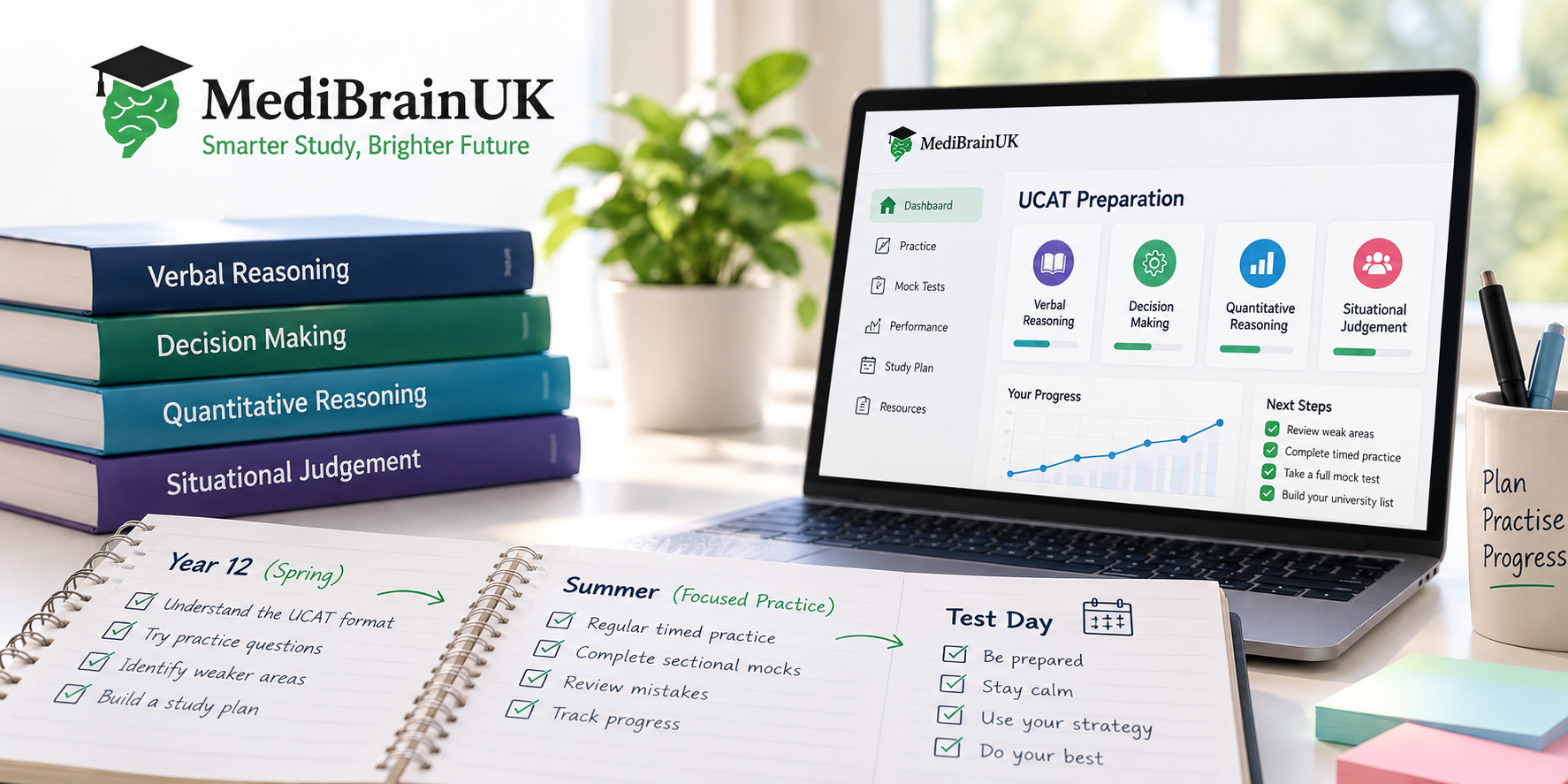
Your preparation should normally progress from learning the question styles and techniques, to targeted practice, to timed section work and eventually full mocks under realistic conditions.
A sensible booking decision therefore considers:
- how many weeks of focused preparation you can realistically complete;
- your current performance and weakest sections;
- how quickly your accuracy and timing are improving;
- school, work, travel and family commitments;
- time for full mocks and detailed review;
- and, where possible, some flexibility before the end of the testing window.
Registering and booking without avoidable mistakes
When registration opens, follow the official UCAT registration and booking instructions carefully.
Use your legal name correctly and make sure your details are consistent with the identification you intend to present on test day. Identification problems are much easier to resolve weeks in advance than on the morning of your examination.
Use a personal email address that you check regularly rather than relying solely on a school account that you may later lose access to.
Once your appointment is confirmed:
- save the confirmation;
- add the date and time to your calendar;
- check your test-centre location;
- understand the identification requirements;
- and plan how you will get there.
Do not judge a test centre purely by distance.
A centre that is slightly further away but has a straightforward journey may be preferable to a closer centre that requires several unreliable connections. Consider what the journey will actually be like at the time of day you are travelling.
Reducing avoidable uncertainty on test morning is part of good preparation.
Access arrangements should be considered before booking
If you require access arrangements because of a disability or another eligible need, investigate them early.
This is particularly important because arrangements requiring approval — such as extra test time, rest breaks or certain other accommodations — need to be approved by the UCAT Office before the appropriate test is booked.
You cannot simply add approved access arrangements to an existing standard booking.
The evidence required depends on your circumstances and educational status, so check the current UCAT access-arrangements guidance carefully rather than assuming that documentation accepted by your school will automatically be sufficient.
If you currently receive examination arrangements at school or college, speak to your SENCO, examinations officer or appropriate member of staff early enough to obtain the necessary evidence.
Access arrangements exist to provide eligible candidates with fair access to the assessment. Organising them early also prevents administrative uncertainty from interfering with your preparation.
Check whether you qualify for a UCAT bursary
Eligible UK candidates may be able to receive financial support through the UCAT Bursary Scheme.
An approved bursary can be applied when booking to waive the test fee. Eligibility criteria, evidence requirements and deadlines should always be checked directly against the current UCAT rules.
If you believe you may qualify, investigate this early rather than waiting until your preferred test dates are beginning to fill.
Once you have booked, turn the date into a preparation plan
A UCAT appointment is useful only if it changes the way you prepare.
Once your date is confirmed, work backwards and give each stage of your preparation a purpose.
Early preparation might focus on understanding question types and developing techniques. The middle phase should increasingly introduce timed practice. Later preparation should combine targeted weakness work with realistic mocks and detailed error analysis.
For example, one week might focus heavily on improving Decision Making accuracy, particularly syllogisms or probability.
Another might concentrate on completing Quantitative Reasoning sets under time pressure, followed by a detailed review of questions where you calculated correctly but took too long.
This distinction matters.
A correct answer that takes two minutes can still reveal a UCAT problem.
Do not judge your progress only by mock scores
Students naturally focus on their mock scores, but the number alone does not explain what needs to improve.
After each timed set or mock, ask:
Where did I lose marks?
Then go further:
Why did I lose them?
Was the underlying problem knowledge, interpretation, timing or decision-making?
Did you misread a qualifier?
Did you spend too long on one data table?
Did you complete a full calculation when estimation would have been sufficient?
Did one difficult question affect your concentration on the next five?
Did you repeatedly reach the final questions with too little time?
This type of error analysis is far more useful than simply completing another mock.
Over time, you should begin to recognise patterns in your mistakes. That is where preparation becomes more targeted and efficient.
Situational Judgement needs consistent preparation too
Situational Judgement should not become an afterthought simply because it is reported separately from the cognitive score.
Medical and dental schools can use Situational Judgement results differently in their selection processes.
Preparation should therefore focus on understanding the principles behind appropriate professional behaviour: patient safety, honesty, confidentiality, teamwork, communication and appropriate escalation.
Avoid trying to memorise rigid rules for every scenario. Good judgement often depends on context, but patient welfare, professional responsibility and acting within appropriate boundaries should remain central to your reasoning.
Your UCAT result should change your university strategy
This is where UCAT planning connects directly with medical school selection.
Before the test, you may have a list of universities you would like to attend. After receiving your UCAT result, that list needs to be reconsidered against how individual medical schools actually select applicants.
A UCAT score should never be interpreted in isolation.
One university may place substantial emphasis on UCAT when deciding whom to interview. Another may combine it with GCSE performance. Some may use Situational Judgement as part of selection, while contextual criteria, qualification route, achieved or predicted grades and other academic requirements can also change the strength of an application.
This means the important question after receiving your result is not simply:
“Is my UCAT score good?”
A more useful question is:
“Which medical schools make the best use of my complete applicant profile?”
How ApplySmart™ can help after your UCAT result
This is the stage where a structured comparison tool can be particularly useful.
MediBrain UK's ApplySmart™ is designed to assess medical school choices using more than a UCAT score alone. The aim is to bring the main parts of an applicant's profile together before comparing them with university selection requirements.
Depending on the applicant and university, this can include factors such as:
- UCAT score;
- Situational Judgement result;
- GCSE performance;
- predicted or achieved qualifications;
- subject requirements;
- qualification route;
- contextual information;
- domicile or fee-status considerations;
- and university-specific admissions criteria.
This matters because the same UCAT result can represent very different levels of competitiveness at different universities.
Rather than producing a generic list based only on a score, ApplySmart™ is intended to help applicants distinguish between universities that appear stronger matches, realistic possibilities and more ambitious choices based on the wider profile.
For example, an applicant with a strong academic record but a UCAT score below the level commonly associated with highly UCAT-weighted universities may need to look more carefully at medical schools where their academic profile or other selection factors carry greater weight.
Conversely, an applicant with a strong UCAT score should still check GCSE thresholds, required subjects, contextual rules and other eligibility criteria before assuming that the university is a safe choice.
The tool therefore supports the decision-making stage rather than replacing it. University admissions policies can change between cycles, and applicants should always verify important requirements against the medical school's current published information before submitting their UCAS choices.
Used properly, this turns the UCAT result from a number into something much more useful: one part of a strategic medical school application.
Think about university choices before you sit the UCAT
Although your final shortlist should normally wait until you know your score, university research should begin earlier.
You should already have some understanding of:
- which medical schools use the UCAT;
- how heavily they appear to weight it;
- their academic requirements;
- whether your GCSE profile is suitable;
- relevant contextual criteria;
- and any other important eligibility requirements.
Then, when your result arrives, you are refining an informed shortlist rather than starting your research from zero.
This is particularly useful because the period between UCAT testing and the UCAS Medicine and Dentistry deadline can pass quickly once Year 13 begins.
What should you do in the final week before your UCAT?
Your final week should feel structured rather than frantic.
You still need timed practice, but repeatedly completing full mocks simply because the test is approaching can become counterproductive.
If a mock exposes a particular weakness, return to the underlying skill. Complete a smaller targeted set, understand the errors and then test the technique again under timed conditions.
You are looking for stability, not perfection.
Several days before your appointment, confirm:
- the date and time;
- the test-centre address;
- your route and expected travel time;
- the current photo-identification requirements;
- and the official test-day rules.
Protect your sleep as far as possible and avoid completely changing your routine immediately before the examination.
What if something goes wrong?
Understand the current UCAT rescheduling and cancellation rules before test day rather than discovering them during an emergency.
This is another reason to avoid unnecessarily booking the final available test date. If you become ill or encounter another serious problem near the end of the testing window, appointment availability may be extremely limited.
If a problem occurs during the examination itself, follow the official test-centre procedure at the time. Do not simply complete the test and assume that an issue can easily be reconstructed afterwards.
Final thoughts
Good UCAT planning begins before you answer your first timed question.
Choose a test date that reflects your own preparation needs rather than somebody else's timetable. Arrange access requirements or financial support early if they apply to you. Use your booking date to create structure, and review your practice by looking at the reasons behind mistakes rather than obsessing over individual mock scores.
Most importantly, remember what the UCAT is ultimately for.
Your score is not the end of the application strategy. It is information that helps you decide where your overall profile may be most competitive.
Once you receive your result, combine it with your academic record, Situational Judgement performance, contextual circumstances and the selection methods used by individual universities. Tools such as ApplySmart™ can make that comparison more systematic, but the final decisions should always be checked against current university admissions information.
A well-planned UCAT journey therefore has three stages:
book intelligently, prepare deliberately, and apply strategically.
That approach gives you something valuable before you even enter the test centre: a clear plan and a better understanding of how each stage fits into the wider Medicine or Dentistry application.