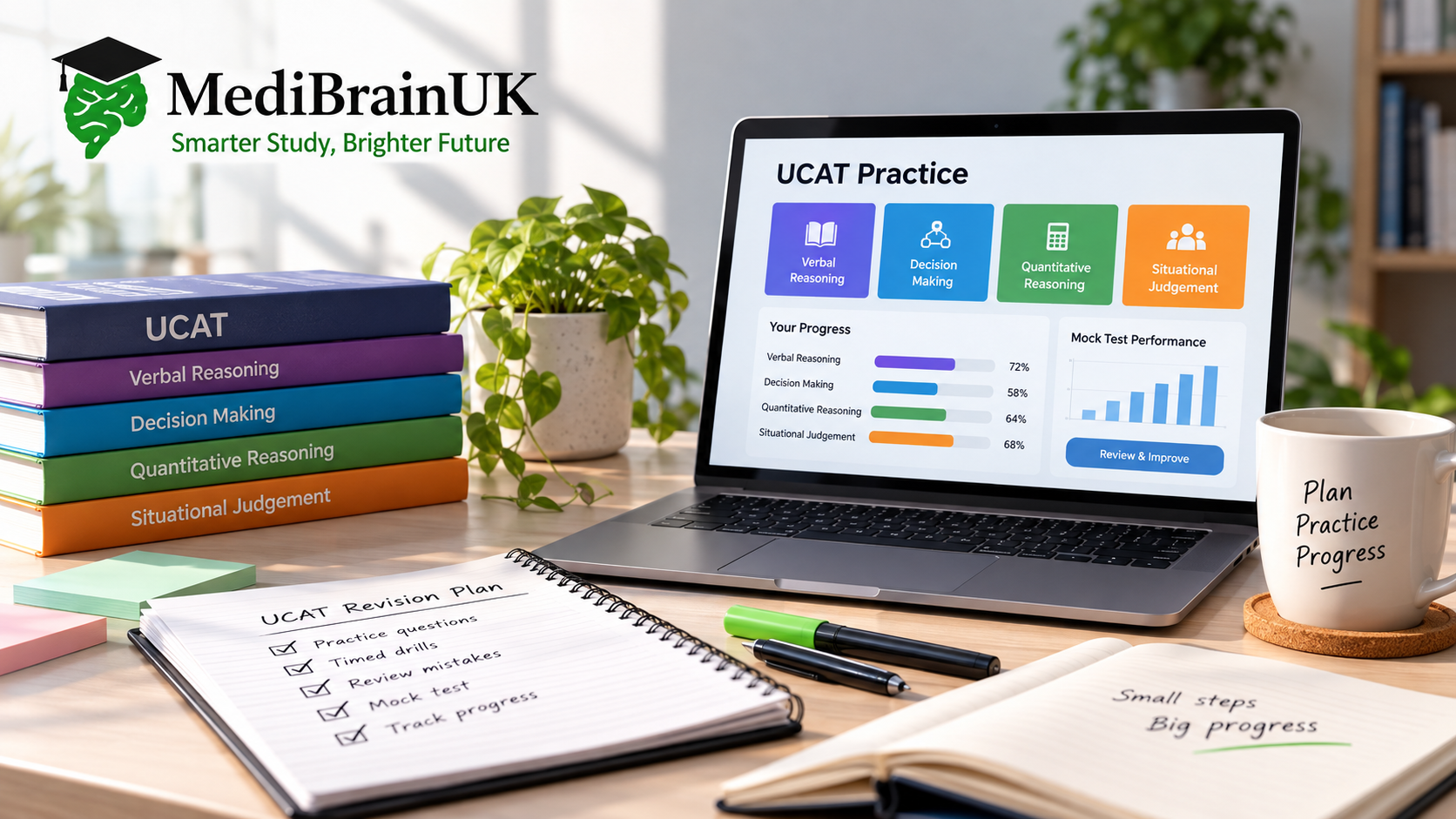
A strong UCAT performance is rarely the result of an intense fortnight spent working through question banks. More often, it comes from a structured plan that fits around school, identifies what is limiting your performance and gradually prepares you to work accurately under time pressure.
If you are deciding how to plan your UCAT revision, it helps to think of the UCAT as a performance-based assessment rather than a content-heavy A-Level subject. You are not trying to memorise a large syllabus. You are developing a combination of technique, speed, judgement, concentration and decision-making.
That distinction matters. The UCAT does not reward cramming facts. It tests how efficiently you can process information, make decisions and maintain judgement under pressure.
Your revision therefore needs structure, but it also needs flexibility. A timetable that looks impressive on paper but falls apart during mock exams, coursework deadlines or a difficult week at school is not an effective plan.
Start Your UCAT Revision Plan With a Diagnostic
Before setting yourself a target of three hours a day or working through hundreds of questions, establish your starting point.
Begin with a short set of untimed questions in Verbal Reasoning, Decision Making, Quantitative Reasoning and Situational Judgement. Once you understand the format of each section, complete a timed mini-mock.
Do not worry excessively about your first score. A diagnostic score is a starting point, not a prediction of your eventual UCAT performance.
Its purpose is to show you where your preparation time is most likely to make a difference.
One student may find Quantitative Reasoning relatively comfortable but repeatedly run out of time in Verbal Reasoning. Another may understand Decision Making questions when working without a timer but make avoidable errors as soon as time pressure is introduced.
Those students should not follow identical revision plans.
After your diagnostic, record:
- your score or accuracy;
- how many questions you attempted;
- the question types you missed;
- how much time you used; and
- why you think each significant mistake happened.
That final point is particularly important.
A wrong answer caused by poor technique needs a different solution from one caused by rushing, weak calculator skills, misreading a qualifier or spending too long on a difficult question.
Set yourself a realistic target range, rather than allowing your confidence to depend on one exact number. Your eventual UCAT performance will be important when choosing universities, but medical-school application strategy involves considerably more than one test score.
How to Plan UCAT Revision Around School
For most applicants, a phased timetable works better than starting at maximum intensity.
Beginning early gives you time to develop your technique properly. Starting too aggressively, however, can leave you mentally tired weeks before your actual test.
The exact timetable will depend on your school commitments, starting point and test date, but a three-stage progression works well for many students.
Phase One: Learn the Format and Techniques
Use your first two to three weeks to understand what each subtest requires.
At this stage, work mainly untimed or with generous time limits. Your priority should be accuracy and method rather than speed.
That might mean learning how to identify the quickest route through a Quantitative Reasoning calculation, understanding assumptions in Decision Making or recognising when a difficult Verbal Reasoning question should be skipped and revisited.
Aim for approximately three or four focused sessions each week, lasting around 30–45 minutes.
After each session, review your mistakes carefully. Completing hundreds of questions is of limited value if you repeatedly make the same mistake without understanding why.
Phase Two: Build Speed Without Sacrificing Accuracy
Once your methods are becoming reliable, gradually introduce timed practice.
Work on individual subtests using shorter timed sets before expecting yourself to perform consistently across an entire mock.
For example, a short Quantitative Reasoning drill can help you establish whether you are losing time because of calculator use, interpreting tables and graphs, unnecessary calculations or difficulty deciding when to move on.
At this stage, you might increase to four or five sessions per week where school commitments allow.
Keep at least one session focused primarily on reviewing your error log.
If you repeatedly lose marks on a particular question type, create a targeted practice block for it. Do not assume that completing another full mock will automatically correct the problem.
Phase Three: Practise the Whole Test Experience
During the final three to four weeks, introduce regular full mocks under realistic conditions.
Use the correct timings, work somewhere quiet and avoid pausing the test whenever a section becomes uncomfortable.
The purpose is not simply to generate another score.
You are training yourself to maintain concentration, make decisions under pressure and recover psychologically after a difficult section rather than allowing one poor section to affect the next.
For many students, one or two properly reviewed full mocks each week can be more productive than taking a mock every day.
A mock only becomes valuable when you learn from it.
Between full mocks, return to shorter targeted drills based on the weaknesses the mock exposed.
Put Your Weekly UCAT Timetable on One Page
A good UCAT plan should be simple enough to follow when school becomes busy.
Avoid writing vague tasks such as:
“Do UCAT tonight.”
Instead, give every session a purpose.
For example:
Tuesday — 30 minutes: Verbal Reasoning timed drill + review
Thursday — 30 minutes: Decision Making probability and logic
Saturday — 45 minutes: Quantitative Reasoning timed practice
Sunday — mini-mock + error-log review
During a demanding week of internal assessments, you might reduce your UCAT preparation to two short sessions rather than abandoning it completely.
Maintaining the habit is often more valuable than forcing yourself through a six-hour revision session when you are exhausted.
Where possible, schedule longer sessions for weekends or quieter evenings and protect at least one evening each week from UCAT preparation.
Students applying for Medicine and Dentistry are often highly conscientious. That is a strength, but excessive preparation can eventually become counterproductive. Fatigue can make you slower, less accurate and more anxious.
Rest is part of performance preparation, not time wasted.
Use Each UCAT Subtest Differently
A balanced revision timetable does not mean allocating exactly the same amount of time to every section.
Your weaker sections should receive additional attention, while stronger areas need enough regular practice to prevent them from slipping.
Verbal Reasoning
Verbal Reasoning requires disciplined timing and a willingness to move on.
A common mistake is reading every passage as though it were an English examination. UCAT passages need to be handled strategically.
Practise locating relevant evidence quickly, distinguishing what the passage actually states from what might merely seem reasonable, and recognising when a question is consuming too much time.
Decision Making
Decision Making rewards precise interpretation.
Do not simply check whether you got a question right or wrong. Review why each option is valid or invalid, particularly when working with logical puzzles, arguments and probability.
Rushing towards an answer may feel efficient, but it can conceal weaknesses in your reasoning.
Quantitative Reasoning
Quantitative Reasoning is as much about selecting an efficient method as it is about mathematical ability.
Become comfortable with calculator functions and time-management techniques, practise estimation and learn to identify information that is irrelevant to the calculation.
If you study A-Level Mathematics, do not assume Quantitative Reasoning will automatically be easy. The underlying mathematics may be straightforward, but performing it accurately at UCAT pace creates a very different challenge.
Situational Judgement
Situational Judgement should be practised throughout your preparation rather than left until the final week.
When reviewing scenarios, consider principles such as patient safety, honesty, confidentiality, teamwork and recognising the limits of your competence.
The objective is not to prove that you already think like an experienced doctor or dentist. It is to demonstrate appropriate professional judgement within the situations presented.
Review Mistakes Like a Coach Would
One of the biggest differences between efficient and inefficient UCAT preparation is how students review their mistakes.
After a timed set or mock, do not look only at the final score.
Ask yourself:
- What happened towards the end of the section?
- Did my accuracy deteriorate?
- Did one difficult question disrupt my rhythm?
- Was I checking calculations unnecessarily?
- Was I trying to answer every question rather than moving on strategically?
- Were my mistakes caused by technique, timing or concentration?
Keep an error log containing short, actionable observations.
Writing “wrong answer” tells you very little. Instead, make your notes specific and actionable:
“Spent 90 seconds on one data table.”
“Missed the qualifier in the statement.”
“Used a full calculation when estimation would have been sufficient.”
Each of these gives you something specific to improve in your next practice session.
This is also where experienced feedback can be useful. Another person can sometimes identify an inefficient habit that is difficult to notice yourself. Good UCAT coaching should therefore focus on the patterns behind performance rather than simply asking a student to complete more questions.
Know When to Adjust Your UCAT Revision Plan
Your timetable should respond to evidence rather than remain fixed simply because you wrote it several weeks ago.
If your scores are improving but your concentration falls towards the end of the test, introduce more full-test practice.
If you regularly finish sections early but your accuracy is inconsistent, slowing down slightly may produce a better result.
If you repeatedly run out of time, identify where the time is being lost before simply completing more mocks.
One disappointing mock should not cause you to change your entire strategy.
UCAT scores naturally fluctuate between practice tests. Look for patterns across several attempts, particularly in timing, accuracy and recurring question types.
Connect Your UCAT Progress to Medical-School Strategy
As your preparation progresses, your practice scores begin to provide another useful piece of information: how your developing UCAT profile may fit with different medical schools.
This is where applicants need to be careful.
A UCAT score should not be viewed in isolation, and a university should not be labelled “safe” or “risky” purely because of one number. Medical schools can use the UCAT in very different ways. Some may place considerable emphasis on it during shortlisting, while others assess it alongside GCSEs, predicted or achieved qualifications, contextual information, Situational Judgement performance and other eligibility criteria.
This is where ApplySmart™ by MediBrain UK can help applicants examine their options more systematically.
Rather than acting as a simple UCAT score checker, ApplySmart brings together multiple parts of an applicant's profile. Depending on the medical school's published selection process, these can include:
- UCAT performance;
- Situational Judgement Band;
- GCSE profile;
- predicted or achieved academic results;
- required subjects;
- contextual or widening-participation information;
- qualification route;
- practical endorsement requirements where relevant; and
- university-specific eligibility and shortlisting criteria.
The purpose is not to predict an offer. No tool can guarantee an interview or admission outcome.
Instead, ApplySmart helps applicants understand how different elements of their profile interact with a medical school's published entry requirements and selection process.
This becomes particularly useful once you have your actual UCAT result.
For example, a UCAT score that appears disappointing compared with another student's result does not automatically mean that Medicine is no longer realistic. Equally, a relatively strong UCAT score does not make every medical school an appropriate choice.
The more useful question is:
“Which medical schools appear to fit my complete academic and UCAT profile, and where are the important risks?”
That is a better basis for application decisions than choosing universities according to reputation, league tables or a single UCAT cut-off found online.
Admissions criteria and selection processes can change between application cycles. Any assessment should therefore be checked against the latest published information from the relevant university before submitting your UCAS choices.
Avoid Comparing Your Revision Hours With Other Students
One student may prepare effectively with an hour a day. Another may need shorter sessions spread across the week.
The number of hours is not the most useful measure of UCAT preparation.
A better question is:
“What improved because of the session I just completed?”
If you can answer that clearly, the session probably had value.
If you completed 200 questions but cannot identify what you learned from your mistakes, the number of questions is largely irrelevant.
The same applies to other students' mock scores. Constantly comparing scores can encourage unnecessary changes to a revision strategy that may already be working.
Measure progress against your own diagnostic and previous performance.
What to Do in the Final Week Before Your UCAT
The final week should not be your most intense week of preparation.
By this stage, your methods should be established.
Continue with light, targeted practice and, if appropriate, complete a final mock early enough in the week to review it properly. Revisit your error log and remind yourself of the recurring habits you have worked to correct.
As the test approaches, reduce your workload.
Check the practical details of your booking and make sure you know what you need for test day.
Avoid trying to learn several completely new techniques the night before the test. Last-minute changes can undermine methods that have taken weeks to become automatic.
Your aim is to arrive at the UCAT alert, settled and confident in the process you have practised.
A Sustainable UCAT Plan Is Usually the Better Plan
Successful UCAT preparation is not about doing as much work as physically possible.
It is about doing the right work at the right stage.
Start with a diagnostic. Develop accurate methods before chasing speed. Introduce timed practice gradually. Review mistakes properly. Use full mocks to develop stamina and test-day decision-making, and adjust your timetable according to evidence.
Most importantly, build a revision plan that can coexist with school, sleep, family life and the rest of your medical-school application.
A well-designed UCAT timetable does more than prepare you for one examination. It teaches you to recognise weaknesses, respond to evidence and perform under pressure without allowing preparation itself to become overwhelming.
That is what effective UCAT preparation should achieve.