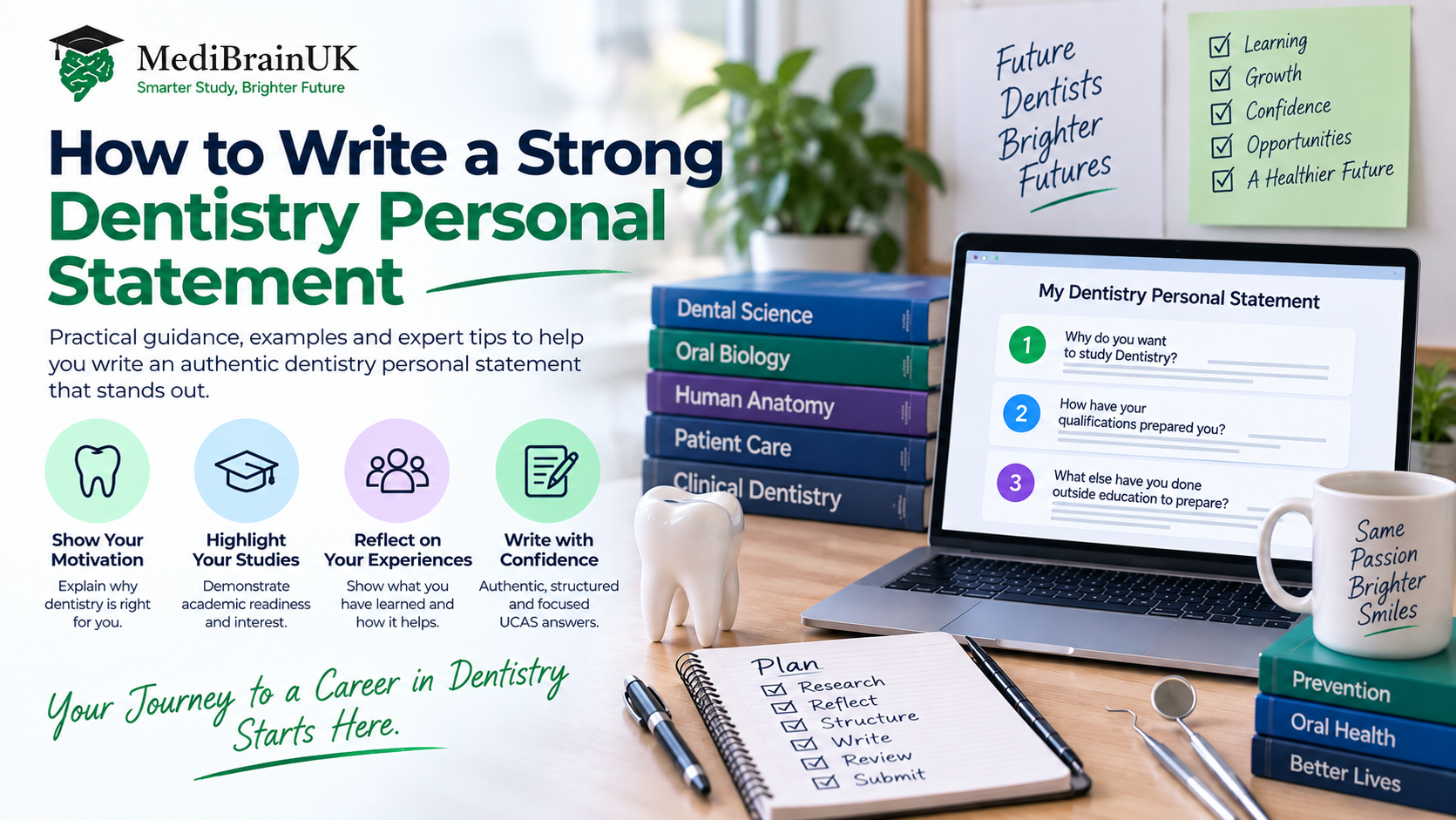
A dentistry application can look strong on paper and still fall short if the written responses do not show what sits behind the grades. Good dentistry personal statement support is not about finding impressive phrases or copying a successful template. It is about turning your real experiences, academic interests and understanding of patient care into clear UCAS answers that give admissions teams confidence in your motivation.
Dentistry is competitive because the course and career demand more than scientific ability. Dental schools want applicants who can communicate, reflect, work responsibly and understand the realities of caring for people. Your personal statement is one place where you can show that you have started to think carefully about the academic, practical and professional demands of dentistry.
What Makes a Strong Dentistry Personal Statement?
The strongest support starts with strategy, not editing. Before anyone changes a sentence, you need to know what your application must demonstrate. A persuasive dentistry personal statement should show informed motivation for the course, readiness for academic study, relevant skills and thoughtful engagement with healthcare.
This matters even more under UCAS's three-question format. You have 4,000 characters including spaces across all three answers, and each answer must meet the UCAS minimum character requirement. The questions give your writing structure, but they do not remove the need to plan carefully.
If you are still getting familiar with the format, our UCAS Three Question Personal Statement Guide explains what each question is asking and how to organise your evidence effectively.
Each answer should have a distinct purpose while still contributing to one credible picture of you as an applicant. Repeating the same point about communication across every section wastes valuable space. Equally, treating each response as a completely separate mini-essay can make the application feel disconnected.
Good dentistry personal statement help should therefore help you plan the whole response before drafting. That means deciding which evidence belongs in each answer, where your academic interest is strongest and how your experiences connect to the demands of dentistry. It should also protect your own voice. Your final answers should sound authentic and be based on experiences you can confidently discuss.
Start With Evidence, Not Grand Claims
Many applicants begin with a statement such as, “I have always wanted to be a dentist.” It may be true, but on its own it gives an admissions tutor little to assess. A better approach is to support your motivation with a specific experience, observation or academic interest that led you to explore dentistry more seriously.
Perhaps you noticed how a dentist reassured an anxious patient during work experience. Perhaps a conversation with a dental nurse showed you how much teamwork sits behind a smooth appointment. Perhaps studying Biology made you curious about disease prevention, oral microbiology or the relationship between oral and general health.
The experience itself does not need to be extraordinary. Your reflection is what makes it useful.
A reliable structure is:
What happened? → What did I learn? → Why is this relevant to Dentistry?
For example, rather than saying that you “improved communication skills” while volunteering, explain how you adapted your approach for different people, why that mattered and how the experience helped you appreciate the importance of clear, respectful communication with patients.
Avoid turning your statement into a diary of placements, online courses and volunteering. Listing activities shows participation. Reflection shows what you took from them.
If you have limited formal dental work experience, do not invent or exaggerate experiences. You can still draw meaningful evidence from caring responsibilities, customer-facing employment, mentoring, school responsibilities, community involvement and independent exploration of the profession.
How to Structure a Dentistry Personal Statement for the Three UCAS Questions
The three UCAS questions allow you to organise your evidence more clearly. The key is understanding the job of each answer.
Question 1: Why Do You Want to Study Dentistry?
This is where you should demonstrate an informed interest in dentistry, rather than simply saying that you want to help people.
Patient care is central to dentistry, but helping people is not unique to the profession. Explain why the particular combination of science, practical precision, prevention, communication, clinical problem-solving and patient care appeals to you.
Use evidence to support your motivation.
Work experience might have helped you appreciate the importance of patient trust. Independent reading may have developed your interest in oral health and prevention. Observing a dental team could have shown you how dentists, dental nurses, hygienists and other professionals contribute to patient care.
Be realistic as well. Dentistry involves manual skill, clinical responsibility, communication, continued learning and difficult conversations as well as rewarding patient outcomes. You do not need to present yourself as an expert. You need to show that you have explored what the profession involves and have reflected on whether it suits you.
Question 2: How Have Your Qualifications and Studies Prepared You?
This is your opportunity to demonstrate academic readiness for Dentistry.
Do not simply list Biology and Chemistry or repeat your predicted grades. Explain what your studies have developed.
You might discuss:
- a Biology topic that strengthened your understanding of physiology, disease or immunity;
- how Chemistry developed structured problem-solving and your understanding of molecular processes;
- accuracy and evaluation developed through required practicals;
- research and critical thinking developed through an EPQ;
- interpreting evidence and reaching justified conclusions; or
- managing a demanding workload across several subjects.
Choose examples that genuinely reflect your academic experience.
The goal is not to fill the answer with scientific terminology. It is to demonstrate curiosity, disciplined learning and the ability to engage with challenging material.
Question 3: What Have You Done Outside Education to Prepare?
This section can include dental work experience, volunteering, paid employment, caring responsibilities, community activities, sport, mentoring and other relevant experiences.
Do not turn it into a list of hobbies.
Choose examples that add something new to your application.
Sport may demonstrate discipline, teamwork or resilience. Paid employment may show reliability and communication. Volunteering may develop your understanding of dignity, empathy or responsibility. Mentoring younger students may demonstrate your ability to adapt an explanation when someone is struggling.
Where you have completed dental or healthcare work experience, focus on what you observed and learned, rather than trying to make the experience sound more clinically advanced than it was.
Dentistry Work Experience: Reflection Matters More Than Listing
Work experience can provide valuable evidence for a Dentistry application, but simply stating where you went and how long you stayed adds limited value.
Think about individual observations.
Perhaps you saw a dentist change the way they communicated with an anxious patient. You might reflect on why trust and reassurance matter before treatment can progress effectively.
Perhaps you noticed how a dental nurse supported both the clinician and patient throughout an appointment. That could help you reflect on teamwork and the importance of every member of the dental team.
Perhaps you observed a discussion about prevention. Instead of simply writing that “prevention is important”, consider what you learned about communicating advice without judging a patient and why long-term oral health often depends on cooperation between the clinician and patient.
The strongest reflection usually moves beyond what you saw to why it mattered.
Show Reflection Without Overclaiming
Healthcare applicants often feel pressure to sound exceptional. That can lead to statements full of words such as “passion”, “compassion” and “dedication” without evidence.
These qualities matter, but your examples should demonstrate them rather than simply naming them.
It is also wise to avoid claiming that one day of work experience confirmed every aspect of your career choice. A more convincing approach is measured: explain what you observed, what questions it raised and how you explored those questions further.
If shadowing a dentist showed you the importance of consent, for instance, you could reflect on balancing professional knowledge with a patient's need to understand their options and make an informed decision.
This is where mature reflection becomes valuable. You do not need to pretend Dentistry is easy or that you already understand every aspect of the profession. Show curiosity, self-awareness and a willingness to continue learning.
Use Non-Clinical Experience Carefully
Not every example needs to come from a dental practice.
A customer-facing job can demonstrate communication, patience and professionalism. Volunteering can expose you to people with different needs and perspectives. Tutoring can demonstrate how you adapt your communication. Team activities may provide evidence of cooperation and responsibility.
However, avoid forcing every hobby into Dentistry.
Instead of writing:
"Playing football taught me teamwork, which is important for dentists."
ask what actually happened.
Did you have to support a struggling teammate? Resolve disagreement? Remain composed after a setback? Take responsibility when others relied on you?
Specific evidence makes the reflection credible.
Get Dentistry Personal Statement Feedback That Is Specific and Ethical
A first draft is rarely a final draft. However, useful feedback should go beyond correcting spelling and grammar.
Ask whether:
- each response directly answers its UCAS question;
- your motivation for Dentistry is specific and informed;
- your strongest evidence has been prioritised;
- your examples contain enough reflection;
- you have repeated the same evidence unnecessarily;
- your claims are supported by genuine experiences; and
- the writing still sounds like you.
Be cautious with generic model statements or having someone else generate your application for you. Examples can help you understand structure, but they cannot provide your experiences, judgement or voice.
Copying language, embellishing experiences or presenting someone else's ideas as your own can leave you with an application that feels inauthentic and contains claims you may struggle to discuss later.
At MediBrain UK, our Personal Statement Review & Guidance focuses on helping applicants strengthen structure, reflection, clarity and how effectively their evidence answers the UCAS questions while keeping the final statement personal and authentic.
Your written application also connects with the rest of your Dentistry preparation. Anything you include should be something you can discuss calmly and honestly later during an MMI or panel interview.
A Practical Dentistry Personal Statement Drafting Plan
Give yourself time to write in stages.
Start by collecting potential evidence from:
- academic study;
- dental or healthcare work experience;
- volunteering;
- employment;
- wider reading;
- extracurricular activities;
- caring or family responsibilities; and
- other meaningful experiences.
Next, group each example according to the UCAS question it supports best.
Then identify the strongest examples rather than trying to use everything.
Draft freely before cutting. Your first version should capture your thinking; later drafts should improve focus, reflection and clarity.
When editing, ask whether every paragraph has a clear purpose.
Does it demonstrate motivation?
Does it show academic readiness?
Does it provide meaningful reflection?
Does it improve the reader's understanding of why you are suited to Dentistry?
If not, it may be taking valuable space from stronger material.
Read your responses aloud as well. Awkward wording, repeated phrases and sentences that do not sound like you are often easier to hear than to see.
Dentistry Personal Statement Checklist
Before submitting your UCAS answers, check that:
- all three questions have been answered directly;
- your responses stay within the overall UCAS character allowance;
- each answer meets the required minimum;
- your motivation explains why Dentistry, not simply why healthcare;
- academic examples demonstrate more than subject names and grades;
- work experience is reflected on rather than listed;
- non-clinical experiences have a clear purpose;
- you have avoided repeating the same evidence unnecessarily;
- you have not exaggerated your role or responsibilities;
- your writing sounds natural and authentic;
- spelling and grammar have been checked carefully; and
- you could confidently discuss every major example at interview.
Final Thoughts
Your Dentistry personal statement does not need to prove that you are already a dentist.
It needs to demonstrate that you have an academic foundation, informed motivation and reflective mindset that can prepare you to begin studying Dentistry.
Strong Dentistry personal statement help should not replace your ideas with somebody else's. It should help you identify your strongest evidence, organise it effectively and reflect on it with greater clarity.
Start early. Choose evidence carefully. Reflect rather than list. Keep your claims accurate and your writing authentic.
Your experiences do not need to sound extraordinary. They need to show what you learned and why that learning matters for the future dentist you hope to become.