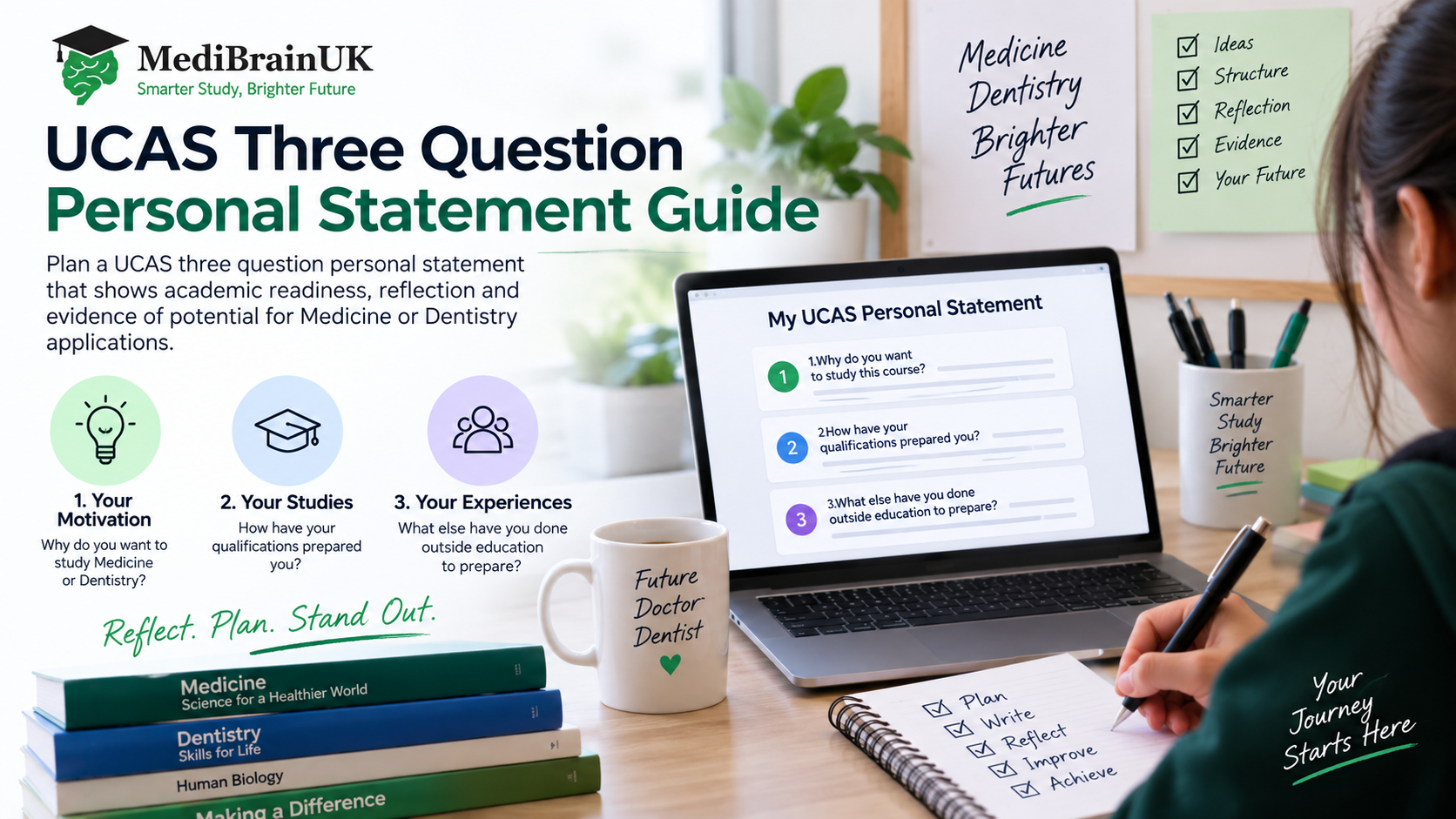
The UCAS three question personal statement has changed how applicants present their experiences, but not what medical and dental schools ultimately want to understand about them.
For Medicine and Dentistry, a strong personal statement should demonstrate genuine motivation, academic readiness, thoughtful reflection and realistic insight into healthcare. The new format gives you three focused opportunities to provide that evidence.
Instead of writing one continuous essay, you now answer three questions:
- Why do you want to study this course or subject?
- How have your qualifications and studies helped you prepare for this course or subject?
- What else have you done outside formal education to prepare, and why are these experiences useful?
You have 4,000 characters including spaces across all three answers, with a minimum of 350 characters for each answer. You can divide the remaining space according to the strength and relevance of your evidence.
For Medicine and Dentistry applicants, this can be an advantage. The structure makes it easier to separate your motivation, academic preparation and wider experiences rather than squeezing everything into one long statement.
The challenge is making every answer specific, reflective and genuinely yours.
What Medical and Dental Schools Want From Your Personal Statement
Your personal statement is only one part of your application.
Admissions teams may consider it alongside your academic qualifications, UCAT performance, reference and, where applicable, contextual information. Different universities also use the personal statement differently within their selection processes.
Your statement therefore should not try to repeat information already obvious elsewhere in your application.
Instead, use it to demonstrate things that grades and test scores cannot fully communicate:
- why you have made an informed decision to study Medicine or Dentistry;
- how you think and learn;
- what you have understood from your experiences;
- how you reflect rather than simply describe;
- what you understand about working with patients and healthcare teams; and
- how your experiences have helped prepare you for a demanding professional degree.
The strongest answers are specific without becoming a diary.
A short example followed by meaningful reflection is usually more powerful than a long list of placements, courses, books and extracurricular activities.
Question 1: Why Do You Want to Study Medicine or Dentistry?
This is where you establish your motivation.
Avoid relying on statements such as:
"I have always wanted to be a doctor."
"I love science and helping people."
These feelings may be completely genuine, but they do not tell an admissions reader enough about why Medicine or Dentistry is the right course for you.
Instead, build your motivation around specific insights.
For Medicine, you might be interested in the relationship between scientific problem-solving, communication, uncertainty and responsibility for patient care.
For Dentistry, you might reflect on the combination of scientific knowledge, clinical precision, prevention, communication and the opportunity to make a visible difference to a patient's health and quality of life.
The exact reason should be yours.
Connect Motivation to Evidence
Rather than simply claiming that an experience inspired you, explain what you learned from it.
For example, perhaps shadowing a GP showed you how clinical decision-making involves more than identifying a diagnosis. You may have observed the doctor balancing clinical uncertainty with the patient's concerns and communicating an appropriate next step.
A dental placement might have shown you that effective prevention advice requires more than giving patients information. The dentist may need to communicate sensitively, build trust and help a patient make realistic behavioural changes.
The important part is not simply what happened.
Ask yourself:
What did I notice? What did it teach me about the profession? Why did that strengthen or challenge my motivation?
That reflection makes your motivation credible.
Show That Your Understanding Is Realistic
Medicine and Dentistry are demanding professions.
Healthcare involves responsibility, teamwork, safeguarding, uncertainty, difficult conversations, pressure and situations where outcomes are not always ideal.
You do not need to make the profession sound negative, but neither should you present an unrealistic picture.
A mature personal statement demonstrates that you have explored what the career involves and remain motivated by meaningful, patient-centred work.
Don't Turn Question 1 Into Your Life Story
This section is about motivation, not biography.
If a personal experience genuinely influenced your decision, you can mention it briefly and sensitively. However, move quickly from what happened to what you learned.
You do not need to disclose private medical information or dramatic personal circumstances to demonstrate commitment to Medicine or Dentistry.
Question 2: How Have Your Qualifications and Studies Prepared You?
Question 2 is your opportunity to demonstrate academic readiness and intellectual engagement.
Medicine and Dentistry are academically demanding courses. Universities need students who can absorb complex information, think critically, work independently and apply knowledge rather than simply memorise facts.
Avoid turning this section into a list of subjects and grades.
Instead, consider what your studies have taught you and how you have developed academically.
Go Beyond Listing Your A-Levels
For example:
Biology might have developed your understanding of physiology, homeostasis, immunity or disease processes.
Chemistry may have strengthened your understanding of molecular interactions while developing structured problem-solving and analytical thinking.
Mathematics can demonstrate logical reasoning, accuracy and confidence interpreting quantitative information.
Psychology may have encouraged you to think more carefully about behaviour, communication, research methods and the interpretation of evidence.
But simply naming these connections is not enough.
Choose something that genuinely interested you and explain how you engaged with it.
Perhaps studying immune responses encouraged you to explore why individuals can respond differently to disease or treatment.
Perhaps learning about research methods made you think more critically about how evidence is collected and why the quality of evidence matters before drawing conclusions.
This shows intellectual curiosity rather than simply repeating your curriculum.
Include Relevant Super-Curricular Learning
This can also be an appropriate place to discuss:
- an Extended Project Qualification;
- independent reading;
- research projects;
- academic competitions;
- lectures or academic programmes; or
- relevant learning beyond your normal curriculum.
Again, the activity itself is not the most important part.
Focus on what it developed.
Did an EPQ teach you how to evaluate conflicting sources?
Did independent reading challenge something you previously believed?
Did a research project teach you how difficult it can be to reach a reliable conclusion from imperfect evidence?
These reflections demonstrate the intellectual habits required for higher education.
Applicants taking Scottish Highers, an Access to HE Diploma, alternative qualifications or applying during a gap year should follow the same principle: identify the strongest evidence of academic preparation and explain its relevance clearly.
Question 3: What Have You Done Outside Education to Prepare?
For many Medicine and Dentistry applicants, Question 3 provides some of the strongest opportunities for reflection.
You might discuss:
- medical or dental work experience;
- clinical shadowing;
- volunteering;
- paid employment;
- caring responsibilities;
- community involvement;
- leadership;
- mentoring or tutoring;
- sport or other sustained commitments; or
- relevant activities outside formal education.
The objective is not to build the longest list.
Admissions teams are interested in what you understood from your experiences and how those experiences contributed to your preparation for the course.
Work Experience: Reflection Matters More Than a List
Suppose you completed work experience in a hospital, GP surgery or dental practice.
Simply stating where you went and what you observed adds limited value.
Instead, identify a meaningful observation.
Perhaps you noticed how a receptionist helped an anxious patient feel more comfortable before an appointment.
Perhaps you observed how members of a multidisciplinary team communicated information while maintaining appropriate professional boundaries.
Perhaps a dental placement demonstrated how carefully clinicians need to explain treatment options and prevention advice while respecting patient autonomy.
Then reflect on the significance.
What did the experience teach you about:
- communication;
- empathy;
- teamwork;
- confidentiality;
- professionalism;
- patient safety;
- responsibility; or
- the realities of healthcare?
This is where an ordinary observation can become strong personal statement evidence.
Non-Clinical Experience Can Be Valuable Too
You do not need extensive hospital experience for every useful example.
Employment and volunteering can provide excellent evidence when reflected on properly.
Working in a café might have taught you how to remain calm and communicate effectively with different people during busy periods.
Tutoring or coaching younger students might have taught you to change your explanation when someone does not initially understand.
Volunteering in your community may have developed reliability, patience or your ability to communicate with people from different backgrounds.
Caring responsibilities may have developed maturity, organisation and an appreciation of the importance of listening.
Do not claim these experiences are equivalent to clinical practice.
Instead, explain honestly what transferable qualities they helped you develop and why those qualities matter in a demanding, people-focused course.
Use the What → So What → Why Medicine/Dentistry Test
A useful way to assess each experience is to ask:
What?
What did I do, observe or learn?
So what?
Why was this significant? What did it teach me or change in my thinking?
Why Medicine or Dentistry?
How does this insight relate to the course or profession I am applying for?
If an example cannot answer the final question convincingly, consider whether it deserves valuable space in your statement.
Don't Overstate Your Experience
Professionalism starts with accurate language.
If you observed a procedure, say that you observed it.
If you volunteered in a healthcare environment, do not imply that you were performing the work of clinical staff.
If you shadowed a doctor or dentist, do not claim responsibility for decisions you merely witnessed.
Admissions teams are not expecting applicants to have clinical expertise before medical or dental school.
They are looking for evidence that you can observe carefully, understand your limitations and reflect maturely.
How Should You Divide the 4,000 Characters?
There is no perfect character split between the three UCAS questions.
Each response must meet the UCAS minimum, but your overall 4,000-character allowance can be distributed according to the quality and relevance of your evidence.
For Medicine and Dentistry applicants, motivation and reflection on experiences may require substantial space, while Question 2 still needs enough depth to demonstrate academic readiness.
Do not force every answer to be exactly the same length.
Instead, ask:
What is the strongest evidence I have for each question?
Then allocate your characters accordingly.
How to Draft Your Three Answers
Start by planning each question separately.
For each one, write down the evidence you could potentially use before trying to create polished sentences.
Then decide which examples belong where.
This helps prevent one of the biggest problems with the three-question format: repetition.
Once you have drafted all three responses, read them together.
They should feel like three parts of the same application.
Your academic curiosity should support your motivation. Your experiences should demonstrate that you have explored the profession beyond the classroom. Together, the answers should provide a coherent picture of why you are prepared for Medicine or Dentistry.
Common UCAS Personal Statement Mistakes
Before submitting, check carefully for these weaknesses:
- generic claims such as "I am passionate about Medicine" without evidence;
- repeating the same experience across multiple questions;
- describing work experience without explaining what you learned;
- listing subjects rather than demonstrating academic engagement;
- including extracurricular activities without explaining their relevance;
- trying to sound overly sophisticated instead of writing naturally;
- exaggerating your responsibilities during work experience;
- using medical terminology simply to sound impressive; and
- filling characters with information that does not strengthen your application.
Every sentence should earn its place.
Keep the Statement Authentic
Your personal statement needs to sound like you.
Feedback can strengthen structure, clarity and reflection, but the experiences, reasoning and final answers should remain your own.
You should also be comfortable discussing anything you include if it comes up later during an interview.
Do not invent experiences or exaggerate what you learned simply because you think an admissions team wants to hear it.
A credible, thoughtful reflection is more persuasive than an impressive-sounding claim that you cannot explain.
Get Strategic Feedback Before You Submit
Once you have a complete draft, do not ask reviewers simply:
"Is my personal statement good?"
Ask more useful questions:
- Is my motivation specific?
- Have I demonstrated rather than claimed my qualities?
- Is there enough reflection?
- Am I repeating evidence?
- Does each answer actually address its UCAS question?
- Does the statement sound authentic?
- Have I explained why my experiences are relevant to Medicine or Dentistry?
At MediBrain UK, our Personal Statement Review & Guidance is designed around this process.
We provide detailed proof-reading, suggested edits, feedback on structure and reflection, and a consultation to discuss how your answers can be strengthened.
For applicants who need more support developing their responses, our Personal Statement Development support works from your own experiences and ideas, helping you shape each of the three questions while keeping the final statement authentic and personal to you.
Final Personal Statement Checklist
Before submitting your UCAS personal statement, make sure:
- all three questions are answered directly;
- each answer meets the UCAS minimum character requirement;
- the complete statement stays within the overall character limit;
- your motivation for Medicine or Dentistry is specific;
- your academic section demonstrates intellectual engagement;
- experiences are reflected on rather than simply listed;
- examples are not unnecessarily repeated;
- your responsibilities are described accurately;
- every major example connects back to your suitability for the course;
- spelling and grammar have been checked carefully; and
- every statement is something you could confidently explain at interview.
Final Thoughts
A successful UCAS three question personal statement for Medicine or Dentistry is not about collecting the most impressive experiences.
It is about showing that you have thought carefully about the profession, prepared for the academic demands of the degree and learned meaningfully from the opportunities available to you.
Use Question 1 to establish why this career is right for you.
Use Question 2 to demonstrate how you are academically prepared.
Use Question 3 to show how your experiences have developed your understanding and readiness.
Keep your answers specific, reflective and authentic.
Your goal is to leave the reader with a clear impression: you understand what you are applying for, you have taken meaningful steps to prepare, and you can explain what those experiences have taught you.