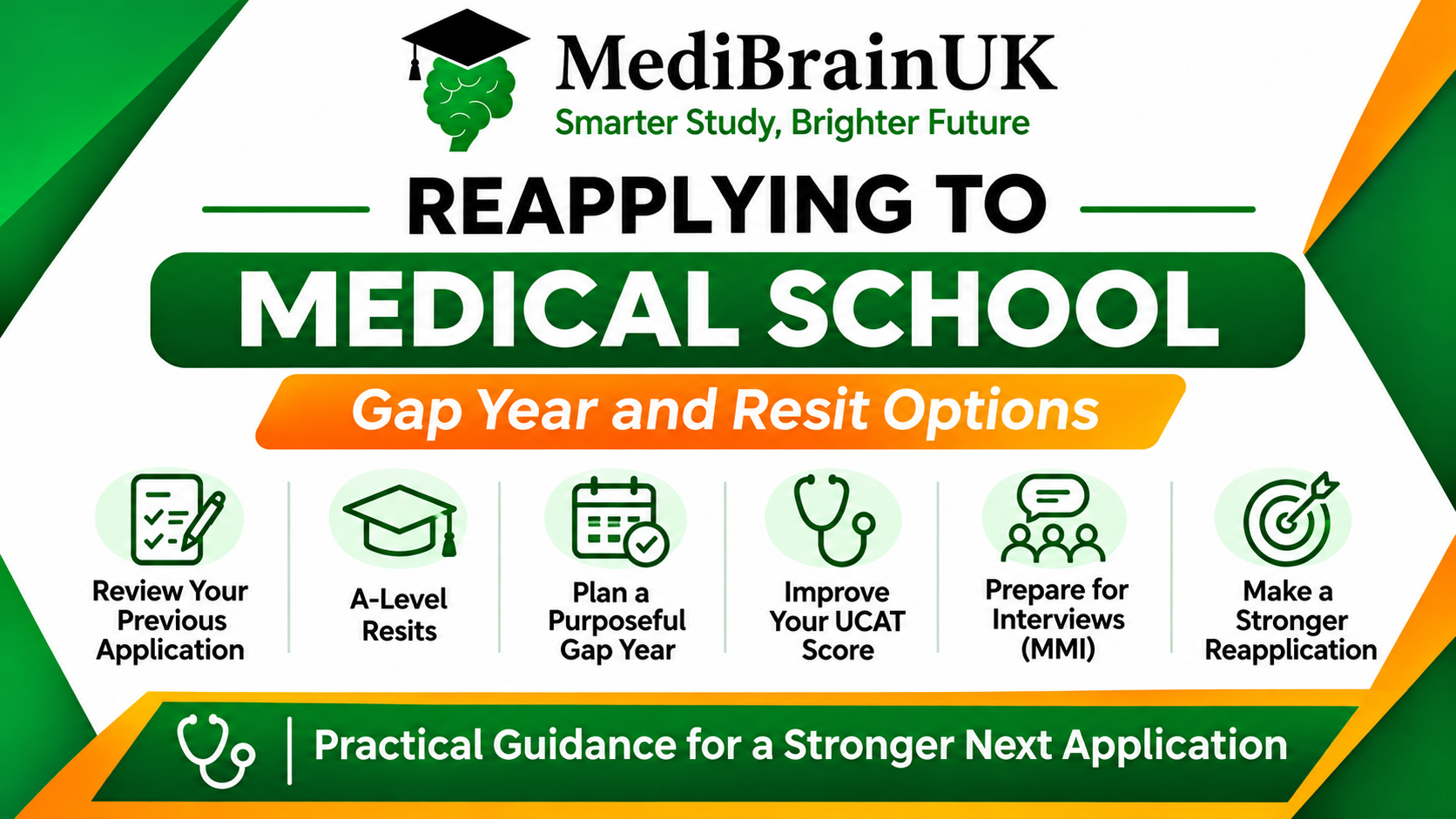
Receiving no offers from medical schools can be disappointing, especially after months of preparation and hard work. However, an unsuccessful application does not mean the end of your ambition to study Medicine. Many applicants choose to reapply after a gap year, using the time to address specific weaknesses rather than simply submitting the same application again.
Taking a gap year can give you time to strengthen your medical school application, whether that means improving your UCAT score, gaining relevant experience, preparing for interviews or resitting A-levels where necessary. You might already have the grades you need; in that case, resitting exams may not help. The right approach depends on what happened in your first application and the entry requirements of the medical schools you are considering.
First, understand why your application was unsuccessful
Before committing to another cycle, review each decision carefully. A rejection before interview requires a different response from an unsuccessful interview.
- No interview invitations: Check academic requirements, UCAT performance, shortlisting methods, contextual eligibility and whether your application met each course's stated criteria.
- Interviews but no offers: Focus on interview performance, including communication, motivation, reflection and ethical reasoning. Do not assume you know the reason without feedback.
- An offer missed because of grades: Compare your achieved results with the conditions of the offer and investigate resit policies before booking examinations.
- A mixture of outcomes: Look at each university separately. Medical schools use different selection methods, so a single explanation may not fit every decision.
Request feedback where available. Some universities provide limited or no individual feedback, but your UCAT score report, achieved grades, interview notes and the admissions policies for your original choices can still help you identify patterns.
Write down three things: what was within your control, what needs to change and what evidence would show improvement. This turns disappointment into a workable plan.
Option 1: Take a gap year and reapply to medical school
If you already meet the academic requirements, a well-planned gap year may be the most straightforward option. It offers time to prepare for a fresh admissions cycle without balancing every task against school examinations.
A useful gap year does not need to be packed with prestigious placements. It needs to help you develop the qualities and understanding that medical schools assess.
Gain experience and reflect on it
Paid employment in care, retail, hospitality or another public-facing role can develop communication, teamwork, reliability and empathy. Volunteering, caring responsibilities, shadowing and healthcare-related activities may provide further insight. The value lies in what you learn, not the number of hours on your CV.
Keep a brief reflection record after meaningful experiences. Ask yourself: What did I observe? What challenged my assumptions? How did I respond? What did I learn about working with people who have different needs? How has this influenced my decision to study Medicine?
For example, supporting an anxious customer might teach you to listen before offering solutions. Observing a multidisciplinary healthcare team might help you understand professional roles, continuity of care and the limits of an individual clinician's responsibility.
Plan your time realistically
A gap year may also involve earning money or supporting your family. Those responsibilities are worthwhile and can help you develop useful skills. Avoid assuming you must volunteer every week or secure a hospital placement. Build a plan that leaves enough time for UCAT preparation, the UCAS application and interviews.
Option 2: Resit A-levels if you need higher grades
If you missed the grades required for Medicine, A-level resits may be worth considering. However, UK medical schools do not share one resit policy.
Some consider applicants who retake qualifications; others restrict resits, require particular grades at the first sitting or make exceptions for documented extenuating circumstances. Requirements can also differ between standard-entry and gateway courses. Policies may change between admissions cycles. For example, Cardiff University’s published variation for 2027 entry restricts consideration of Level 3 resits to applicants who accepted a conditional Cardiff Medicine offer in the previous cycle and provide verified extenuating circumstances; resits taken within the normal two-year A-level period are treated separately. This is one university’s specific policy, not a UK-wide rule. Check Cardiff’s 2027 policy.
Before deciding to resit:
- Check the official entry requirements for your intended entry year.
- Confirm whether the school accepts resits in your circumstances, including the number of subjects and the permitted timeframe.
- Check whether first-sitting grades, predicted resit grades or extenuating circumstances affect eligibility.
- Contact admissions for written clarification if the published policy does not cover your situation.
- Build your shortlist only after confirming that you are eligible.
If Chemistry was your weakest subject, diagnose whether the issue was subject knowledge, unfamiliar exam questions, time management or revision technique. Retaking examinations without changing your approach risks repeating the same outcome.
Resitting several subjects alongside the UCAT and a new application can be demanding. Prioritise the examinations that matter and use a timetable with regular assessment and review.
Option 3: Explore gateway or foundation courses in Medicine
Some universities offer gateway or foundation routes designed to widen participation in Medicine. These are not general alternatives for everyone who missed standard-entry grades.
Eligibility may depend on school background, household circumstances, area-based measures, care experience or participation in specific access programmes. Courses can also have their own academic requirements, admissions tests and progression rules.
Check the exact programme rather than relying on the word foundation. A foundation year in biomedical science does not necessarily provide progression into Medicine. Read the course structure and progression requirements carefully.
If you qualify for contextual consideration, verify what it changes: eligibility, an academic offer, shortlisting or another part of selection. Never assume that meeting one contextual indicator guarantees an interview or offer.
Option 4: Consider another degree carefully
Biomedical science, pharmacy, nursing and allied health professions are worthwhile careers in their own right. Some graduates later apply to Medicine, but a first degree is not a guaranteed route into medical school.
Graduate-entry Medicine can be highly competitive. Admissions tests, degree requirements, funding arrangements and course length vary. Transfers from other degrees into Medicine are uncommon and should not be assumed.
Choose another course only if you would genuinely value studying and potentially working in that field. Dentistry is also a distinct profession, not a backup version of Medicine: its training, day-to-day work and professional responsibilities deserve an independent, informed decision.
Improve your UCAT preparation before applying again
The UCAT Consortium confirms that UCAT 2026 scores are valid only for the 2027 admissions cycle (including permitted deferred entry), not for a later reapplication. Its official FAQs also confirm that candidates may sit the test once per year and that there is no penalty for testing again in a later year. A previous UCAT score cannot be carried into a new admissions cycle. If you reapply to a UCAT-using course, you will need a valid score for that cycle. Always check the current UCAT test format, dates and individual university requirements.
Begin with a timed diagnostic and review errors by cause, not just by question type. Did you misunderstand the information? Use an inefficient method? Run out of time? Make avoidable mistakes under pressure?
Build preparation in stages: learn reliable techniques, practise targeted questions, increase timed work and then complete realistic full-length mocks. Review each mock before moving on. More questions are not necessarily better if the same mistakes remain uncorrected.
Your university shortlist should reflect how each medical school uses the UCAT, alongside academics and contextual criteria. A score that is competitive for one selection process may not be competitive for another. Use the UCAT revision planning guide and the medical school selection guide to plan both tasks together.
When structured support may help
If you are unsure where to focus, MediBrain UK offers UCAT preparation, A-level tuition and medical school application guidance. For example, a student who missed an offer because of Chemistry might use subject tuition to address specific exam weaknesses, while someone with strong grades but no interview invitations might benefit more from reviewing their UCAT preparation and university shortlist. The useful starting point is to identify the problem before choosing support; not every reapplicant needs tuition or coaching.
Show what you have learnt in your new UCAS application
Your new application should show what has changed since you last applied. For applicants using the current three-question UCAS personal statement format, use the questions to demonstrate informed motivation, academic preparation and relevant experience beyond formal education.
Give specific examples, but focus on reflection rather than description. Instead of listing everything you observed in a clinical setting, explain what one interaction taught you about dignity, communication, teamwork or the realities of care. Avoid identifying patients or sharing confidential details.
Be prepared to explain your gap year and reapplication in an interview. You do not need to apologise for applying again. A concise explanation of what you learned, what changed and why Medicine remains an informed choice is more persuasive than blaming a university or presenting the year as a setback with no benefits.
Strengthen your interview skills if you reached that stage
Medical schools may use Multiple Mini Interviews (MMIs), panel interviews or other formats. In an MMI, candidates rotate through several short stations, each assessing particular skills or attributes. Stations may involve motivation, ethical dilemmas, communication, teamwork, role-play, interpreting information or discussing an experience. Formats and timings vary by university.
Practise explaining your reasoning aloud under timed conditions. For ethical scenarios, first identify the central concern and the people affected. Use the GMC’s guidance for medical students rather than dentistry-specific GDC standards: confidentiality, professional behaviour and appropriate escalation are particularly relevant. Consider patient autonomy, informed consent, confidentiality, safety, fairness and professional duties. Explain what further information you would need, acknowledge uncertainty and describe when you would seek senior advice or follow local policy. Do not jump to a confident conclusion without considering competing responsibilities.
For communication stations, listen carefully, acknowledge concerns and respond in clear, accessible language. For motivation questions, connect your experiences to a realistic understanding of the medical profession, including teamwork, pressure, limitations and the importance of patient-centred care.
A mock MMI can expose habits that silent revision misses. For example, in a MediBrain UK practice session, a reapplicant might attempt a timed ethics station and receive specific feedback on their structure, tone and handling of uncertainty. They can then repeat the station with a clearer approach, rather than simply memorising a model answer.
Manage nerves through repeatable practice
Feeling nervous is normal. The aim is not to remove nerves completely but to become familiar with performing while they are present. Use realistic timings, practise with unfamiliar questions and allow a short pause before answering. After each attempt, choose one or two changes to test next time.
MediBrain UK’s interview coaching can include guided practice, mock MMI stations and feedback on communication, ethical reasoning and confidence under time pressure. For instance, a student who rushes through role-play questions can practise listening, acknowledging concerns and giving a more considered response. Good feedback should help you develop your own judgement and speaking style, not memorise a script.
Build a realistic reapplication timeline
| Period | Main priority |
|---|---|
| After decisions and results | Review feedback, grades and admissions eligibility; decide whether resits are necessary. |
| Spring to summer before applying | Prepare for the UCAT, build relevant experience and maintain a reflection record. |
| Before the UCAS deadline | Confirm the current deadline and entry policies; finalise your shortlist and three UCAS responses. |
| Autumn to interview season | Practise interviews, review current healthcare issues and continue meaningful commitments. |
| After offers or decisions | Check conditions, deadlines and next steps rather than assuming the process is complete. |
For 2027 entry, the main UCAS deadline for Medicine was 15 October 2026 at 18:00 UK time and has now passed. If you are preparing for a later entry year, check the official UCAS dates and deadlines for that cycle. Check UCAT registration, testing and access-arrangement deadlines separately.
Make your next application count
An unsuccessful Medicine application can be difficult to process, but your next decision should be based on evidence rather than urgency. Establish whether you need better grades, a different UCAT strategy, more suitable university choices or stronger interview performance. Then choose a gap-year plan that directly addresses those needs.
If interview performance is your main concern, a focused MediBrain UK mock interview or feedback session is one option for checking your progress. Whatever support you use, the goal is the same: return to the application process with a clearer understanding of the profession and a stronger, more realistic plan.