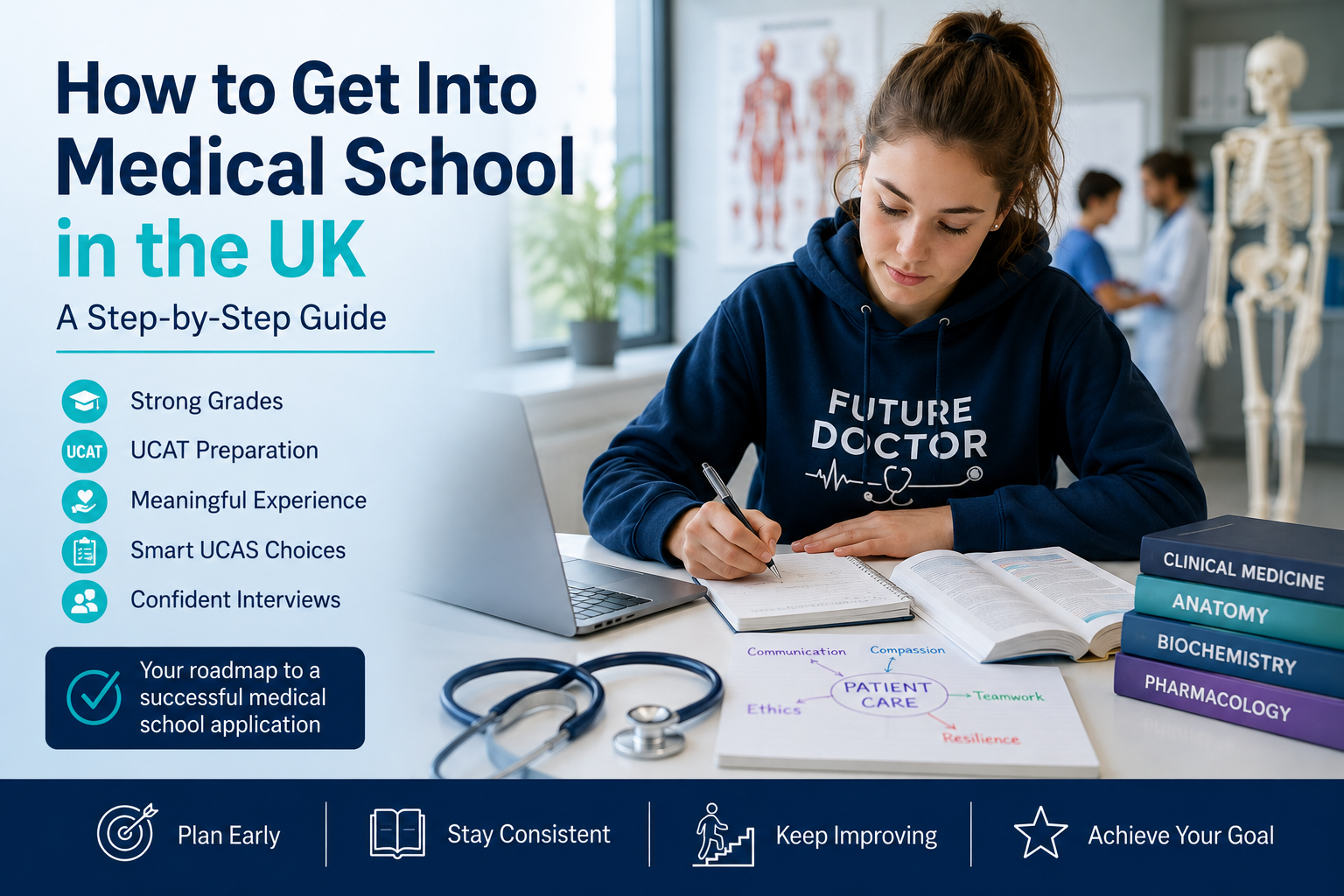
A strong Medicine application is not built in the week before the UCAS deadline. It is built through a series of calm, well-timed decisions: choosing universities that suit your profile, protecting your predicted grades, preparing properly for the UCAT, gaining meaningful experience and learning to explain why you are ready for a career centred on patients.
If you are wondering how to get into medical school in the UK, the answer is not to do everything. It is to focus on the right things, at the right time, and make decisions based on evidence rather than assumptions.
Medical school is competitive because universities are selecting future healthcare professionals, not simply students who can achieve high marks. They are looking for academic potential, sound judgement, communication skills, insight into the realities of healthcare and the ability to develop through a demanding degree. Your application should demonstrate these qualities in a credible and personal way.
Start with medical school entry requirements
Your first task is to research medical schools before committing to an application strategy. GCSE requirements, A-level subject requirements, typical offers, UCAT selection methods, contextual admissions criteria and interview processes can vary considerably between universities.
Do not assume that every medical school requires exactly the same A-level subjects or grades. Many courses require Chemistry and/or Biology alongside another specified subject, while typical offers for standard-entry Medicine are often around AAA to A*AA. Requirements can change, so always check the current admissions criteria for every medical school you are considering.
Predicted grades matter, but they are only one part of the picture. GCSE performance can also be important, particularly at universities that score or rank applicants using their academic profile.
Your four Medicine choices should therefore be deliberate. Match them to your academic results, UCAT performance, contextual eligibility and the way each university selects applicants. You should also consider course structure, teaching style, location and clinical exposure. You are choosing a course you may study for five or six years, not simply trying to secure any offer.
Build a strong academic foundation early
Medicine requires sustained academic discipline. The best preparation is not last-minute revision before mocks, but a reliable weekly routine that begins early and becomes more focused as assessments approach.
Prioritise understanding rather than memorising isolated facts, particularly in science subjects where later topics often depend on earlier knowledge. Use class feedback, topic questions and timed practice to identify whether difficulties come from gaps in knowledge, exam technique or time management. Each problem needs a different response.
If a topic is slipping, address it early. Leaving difficult areas until late in Year 12 can affect predicted grades and reduce the time available for UCAT preparation.
For GCSE students already considering Medicine, the priority should be building strong foundations in science, maths and English while developing good study habits. There is no need to fill every spare hour with activities simply because they might look impressive on a future application.
Prepare for the UCAT as a separate skill
The UCAT is different from an A-level science exam. It is a fast-paced admissions test that rewards familiarity with question types, efficient decision-making, accuracy and the ability to manage time pressure.
Begin by learning the format of Verbal Reasoning, Decision Making, Quantitative Reasoning and Situational Judgement. Then establish an honest baseline using timed questions. Your first score is information, not a verdict on your potential. It helps identify which areas need technical work and where your timing begins to break down.
Strong UCAT preparation should progress from developing accuracy and technique to short timed sets and then full mocks under realistic conditions.
Review is where much of the improvement happens. For every mistake, identify why it happened. Did you misread the question? Use an inefficient method? Make a calculation error? Spend too long on one question? Lose accuracy because you felt rushed?
Repeating large numbers of questions without analysing your mistakes can create the impression of preparation without producing the same improvement.
Choose your test date carefully and give yourself enough time to prepare properly. Remember that the UCAT can normally only be taken once in each annual test cycle, although appointments can be rescheduled within the official rules.
Once you have your final score, revisit your university shortlist. A strong score may make some choices more competitive, while a lower score does not automatically end your Medicine application. It does, however, make strategic university selection even more important.
Gain meaningful experience and reflect on it
Medical schools understand that direct hospital work experience is not equally available to every applicant. What matters is not simply where you completed an experience, but what you learned from it.
A care home placement, charity role, school mentoring, pharmacy observation, first aid work, customer-facing job or other position of responsibility can all provide useful experiences when you reflect on them thoughtfully.
Focus on what you observed about communication, teamwork, dignity, confidentiality, safeguarding, responsibility and the pressures facing staff and patients.
If you volunteered in a care setting, for example, do not simply state that you helped residents. Think about how you adapted your communication, what you learned from a difficult interaction, how staff maintained dignity or how different professionals worked together.
You should also develop a realistic understanding of healthcare and the profession you are applying to join. Follow credible healthcare news and consider issues such as waiting lists, health inequalities, workforce pressures and multidisciplinary care.
You do not need to have solutions to complex NHS problems. You do need to demonstrate that your motivation for Medicine is based on a thoughtful understanding of the profession rather than a general desire to help people.
Turn your UCAS application into evidence
For applicants using the current UCAS format, the personal statement is structured around three questions. Treat this as an opportunity to be precise rather than repeating the same points across all three responses.
Your answers should explain why you want to study Medicine, how your qualifications and studies have prepared you, and what you have done outside formal education that has helped you prepare.
Avoid trying to sound like a doctor. Generic statements are much less persuasive than specific reflection. A statement such as “I have wanted to be a doctor since I was young” only becomes meaningful when you explain how your understanding of Medicine has developed and what experiences have confirmed your motivation.
A convincing response connects experience with insight. Perhaps practical work developed your attention to detail, volunteering taught you to listen without making assumptions, or independent reading made you think more carefully about the relationship between public health and clinical care.
The strongest writing is reflective, concise and genuinely your own.
Your school reference should support the overall application. Give your referee enough time and make sure they are aware of relevant responsibilities, circumstances or academic progress that may help them provide an accurate reference.
Choose medical schools strategically
Strategic university selection is one of the most important parts of a Medicine application.
Once you know your GCSE profile, predicted grades and UCAT result, compare them carefully with the selection process used by each medical school. Do not rely only on headline entry requirements. Two universities with similar minimum grades may shortlist applicants in very different ways.
Look at questions such as:
- Does the university score GCSEs?
- How is the UCAT used?
- Is there a minimum UCAT requirement or competitive ranking?
- Is Situational Judgement considered?
- Are contextual applicants assessed differently?
- How are applicants selected for interview?
- Are there specific subject or qualification requirements?
A balanced shortlist is usually stronger than choosing four universities based mainly on reputation. The aim is to identify medical schools where your individual profile gives you a realistic opportunity to progress to interview.
Prepare for medical school interviews before invitations arrive
An interview is not a test of whether you can memorise model answers. It allows a medical school to assess how you think, communicate and respond when challenged.
In MMIs, you may move through short stations covering ethical scenarios, role-play, teamwork, data interpretation, motivation and healthcare awareness. Panel interviews may explore similar themes in greater depth.
Start by developing clear answers to core questions: Why Medicine? Why this course? What have you learned from your experiences? What qualities are important in a doctor?
Then practise applying your principles to unfamiliar scenarios. For ethical questions, a useful approach is to identify the issue, consider who is affected, recognise competing principles and explain a safe and compassionate next step.
Role-play can feel uncomfortable at first, which is exactly why live practice is valuable. Speak naturally to the person in front of you rather than performing for an imaginary assessor. Listen carefully, acknowledge concerns, avoid making promises you cannot keep and recognise when an issue needs to be escalated.
Feedback should be specific. “Be more confident” is not enough. You need to know whether you rushed your opening, failed to explore another person's perspective, used unclear language or missed an important ethical issue.
Timed MMI practice with detailed feedback can help turn interview preparation into a set of trainable skills.
Keep control of your Medicine application timeline
Medicine has an earlier UCAS deadline than most undergraduate courses. For 2027 entry, the equal consideration deadline is 15 October 2026.
Work backwards from the deadline rather than trying to complete everything at once.
By late spring and early summer, research entry requirements and begin building your initial shortlist. During the summer, continue developing relevant experience, work on your UCAS responses and prepare seriously for the UCAT. Once you receive your UCAT result, reassess your university choices before finalising your application.
After submission, do not switch off. Interviews may arrive later, and your A-level performance still determines whether you meet the conditions of an offer. Keep your revision routine stable, continue developing your understanding of healthcare and practise interview skills consistently rather than cramming immediately before an interview.
If you are applying after a gap year or reapplying, focus on what has changed. A stronger application may include improved academics, a better UCAT performance, sustained employment or volunteering, more strategic university choices and clearer reflection on why Medicine remains the right path.
Final thoughts: getting into medical school is a process
Getting into medical school is not determined by one perfect UCAT score, one impressive placement or one flawless interview answer.
It comes from a sequence of well-informed decisions: building strong academics, preparing effectively for the UCAT, gaining meaningful experience, reflecting on what you have learned, choosing medical schools strategically and preparing properly for interview.
Give each stage the attention it deserves, check current university requirements before making decisions and ask for useful feedback early.
A Medicine application can feel overwhelming when viewed as one enormous task. Break it into manageable stages, focus on the factors you can control and keep your motivation connected to the patients and communities you hope to serve.