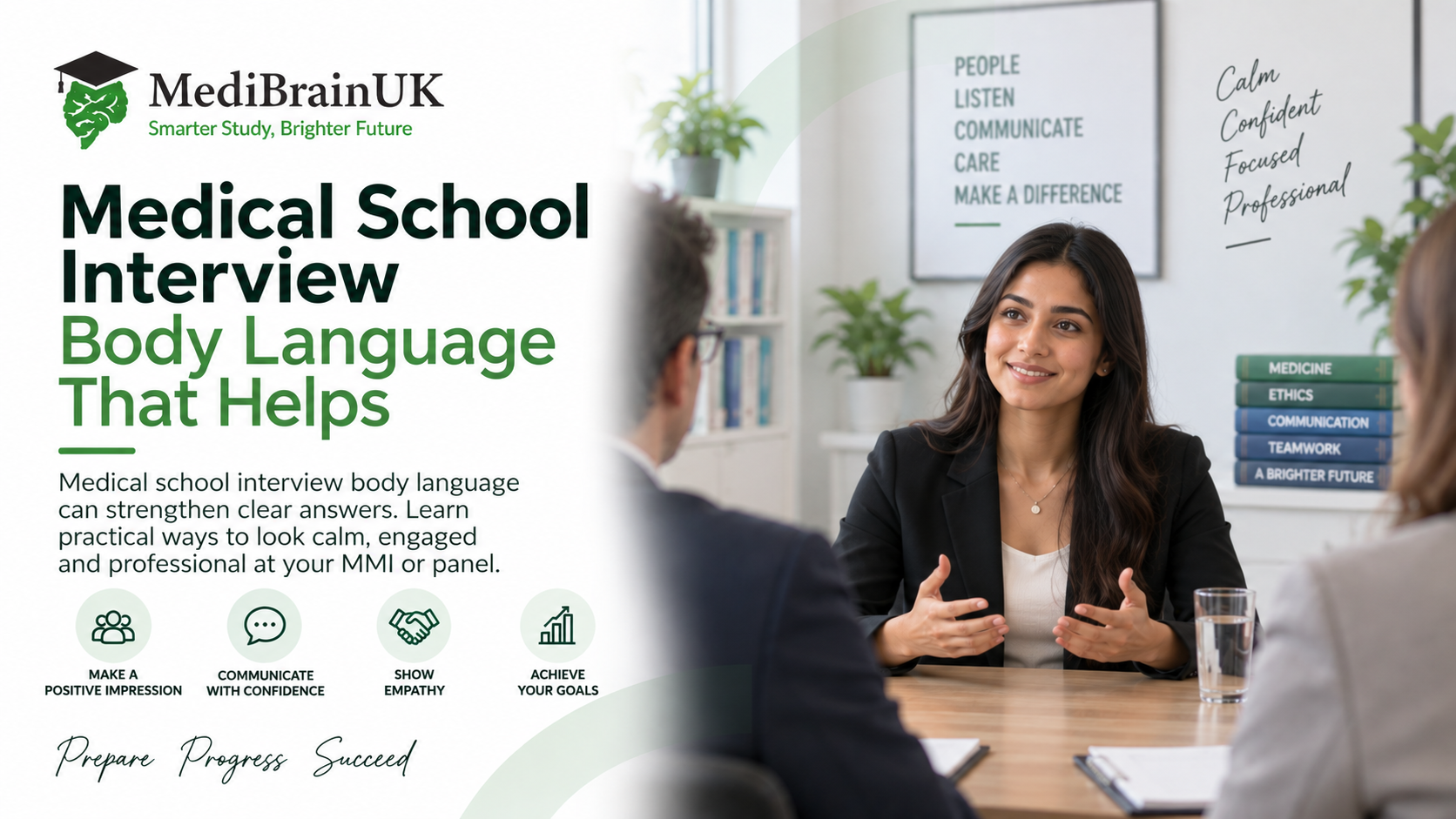
Your first Multiple Mini Interview (MMI) station may last only a few minutes, but an interviewer can begin forming an impression before you have fully explained your first answer. Medical school interview body language is not about acting like someone else or memorising a collection of gestures. It is about helping your non-verbal communication support the qualities you want to demonstrate: calmness, respect, empathy, self-awareness and an ability to engage with other people.
For UK Medicine and Dentistry applicants, this matters because interview communication involves more than the words you choose.
A thoughtful answer can lose some of its impact if it is delivered while looking at the floor, speaking too quickly or appearing disengaged. Equally, you do not need perfect posture, constant eye contact or carefully rehearsed gestures to communicate effectively.
Medical schools are looking for applicants who can engage appropriately and professionally under pressure, not polished television presenters.
Why body language matters in medical school interviews
Medicine is a people-facing profession.
Whether you are completing an MMI role-play, discussing an ethical scenario or responding to a panel question about work experience, assessors are considering how effectively you communicate as well as what you say.
Your non-verbal communication can support your spoken answer.
If you say that you would listen carefully to an anxious patient and then demonstrate attentive listening, allow appropriate pauses and speak at a measured pace, your communication is consistent with your answer.
If you discuss the importance of teamwork while repeatedly interrupting a role-player or appearing disengaged, the same answer may feel less convincing.
This does not mean that every medical school assesses “body language” as a separate marking criterion. Interview formats and assessment criteria vary.
Instead, think of body language as something that can support communication, rapport and professionalism, rather than a trick that can replace strong interview preparation.
Medical school interview body language starts before your answer
The moments before a question are useful because many aspects are within your control.
For an in-person interview, arrive with enough time to settle. Put your phone away, check that you are comfortable and enter the interview space at a natural pace.
Offer a clear greeting and follow the interviewer's instructions.
You do not need to manufacture an elaborate introduction.
The objective is simply to begin the interaction calmly and professionally.
Sit in a way that allows you to think
Aim for a balanced and comfortable position.
Keep your feet grounded where possible, relax unnecessary tension in your shoulders and sit upright without becoming rigid.
Leaning slightly forward while listening can sometimes show engagement, but remaining perched on the edge of your chair throughout an interview may make you feel more tense.
Aim for comfortable stillness rather than complete stillness.
Natural movement is normal.
Try to reduce habits that distract from your answer, such as:
- repeatedly swivelling in your chair
- rocking backwards and forwards
- constantly adjusting clothing
- tapping the table
- clicking a pen
- repeatedly touching your face or hair
If nerves make your hands shake, you do not need to hide them.
Resting them naturally in your lap or on the table may help you feel more settled.
Trying to conceal every sign of nervousness can sometimes create more tension.
Let your facial expression match the conversation
A neutral, attentive expression is appropriate for many medical interview questions.
A natural smile when greeting an interviewer, a slight nod while listening and an expression that reflects the seriousness of a scenario can all support rapport.
The important principle is appropriateness.
For example, avoid smiling continuously during a discussion involving safeguarding, bereavement or patient safety simply because you are nervous.
During an empathy or role-play station, warmth can be valuable, but it should fit the person and situation.
A concerned expression, slower pace and focused attention can often communicate more effectively than exaggerated sympathy.
Use eye contact with purpose, not pressure
Many applicants worry that good medical interview body language means maintaining constant eye contact.
It does not.
Continuous staring can feel uncomfortable and may actually make it harder for you to think.
Instead, aim for natural eye contact.
Look towards the interviewer regularly while speaking, particularly when beginning or concluding an important point.
It is completely natural to glance away briefly while recalling an example or organising your thoughts.
Eye contact in a panel interview
During a panel interview, share your attention naturally.
Begin primarily with the person who asked the question, then include other panel members as you develop your response.
You do not need to move your eyes mechanically from one interviewer to another.
If one assessor is looking down and taking notes, do not attempt to force eye contact with them.
Continue communicating naturally with the panel.
Eye contact during an online medical interview
Online interviews require a slightly different approach.
Position your camera approximately at eye level and choose a distance that allows your face and upper body to be seen comfortably.
Looking at the screen while listening is completely natural.
For an important sentence or central point, briefly looking towards the camera can create a stronger sense of connection.
Good lighting also matters. Your face should be clearly visible without harsh light behind you.
Most importantly, avoid spending the interview watching your own image.
Your attention should remain on the conversation.
Cultural background, neurodiversity, individual communication styles and anxiety can all influence eye contact.
Do not force a behaviour that feels unnatural or distressing simply because you believe there is a perfect interview formula.
Calm, respectful engagement matters more than maintaining eye contact for a prescribed number of seconds.
Make your hands support your message
Natural hand gestures can make an explanation easier to follow.
They may be useful when:
- explaining a sequence
- comparing two perspectives
- weighing ethical considerations
- describing your role within a team
- illustrating how different factors connect
Keep gestures natural rather than choreographed.
Avoid pointing at an interviewer or making movements that become distracting.
If you tend to fidget with pens, jewellery or other objects when nervous, consider removing unnecessary distractions before the interview.
A glass of water can be useful, but it does not need to become an escape from every difficult question.
What should you do with your body when you need thinking time?
Applicants sometimes become visibly uncomfortable when they need a few seconds to think.
They may immediately look at the floor, start filling the silence with “um” or begin answering before they know what they want to say.
A short pause is acceptable.
Stay present.
Take a breath.
Maintain a comfortable posture.
Then begin.
If you genuinely need a moment, you can appropriately indicate that you would like a few seconds to organise your thoughts.
A thoughtful pause usually communicates more confidence than a rushed answer that never reaches a clear point.
Body language during MMI role-play stations
Role-play stations are where non-verbal communication can become particularly noticeable.
You may be asked to interact with an upset peer, worried relative or another person facing a difficult situation.
Applicants sometimes concentrate so heavily on finding the “right” solution that they forget the first task is to understand the person in front of them.
Face the role-player appropriately.
Use their name if it has been provided.
Allow them to finish speaking.
Small acknowledgements such as a natural nod can show that you are following the conversation.
If the person becomes emotional, slowing down may be more appropriate than immediately offering advice.
You might first acknowledge the concern and invite them to explain further.
This demonstrates that you are listening rather than simply waiting for your opportunity to deliver a prepared response.
Respect personal space and professional boundaries
Maintain an appropriate distance from the role-player.
Avoid leaning so far forward that the interaction becomes uncomfortable.
You should also respect professional boundaries.
Physical contact with a role-player is generally unnecessary unless the station instructions specifically make it appropriate.
Professional communication involves respecting another person's space as well as listening to their words.
Body language during panel interviews
Panel interviews create a different challenge because you may remain with the same interviewers for considerably longer than an MMI station.
This means you need to sustain natural engagement.
Avoid becoming so focused on the interviewer asking the questions that you completely ignore the rest of the panel.
Similarly, if an interviewer challenges your answer, try not to allow your posture or facial expression to become defensive.
Listen to the full question.
Pause.
Then respond to the point being raised.
A follow-up question is not necessarily criticism.
It may simply be an opportunity for the panel to explore your reasoning in greater depth. Our guide to medical school panel interview questions explores how to prepare for these conversations.
What happens to body language when interview anxiety rises?
Many body-language difficulties are not actually caused by applicants lacking communication skills.
They appear because anxiety changes how those skills are expressed under pressure.
When nerves rise, you may:
- speak faster
- breathe more shallowly
- tense your shoulders
- look down more frequently
- fidget
- stop using natural gestures
- rush through pauses
- avoid eye contact
- become unusually rigid
- lose your train of thought
This is why simply telling an applicant to “look confident” is rarely useful.
You need to understand what changes in your own communication when pressure increases.
Once you recognise the pattern, you can practise a more useful response.
For example, if you consistently speed up during ethical questions, your goal might be to pause before your first sentence.
If your shoulders become tense, you might practise grounding your feet and releasing that tension before beginning.
If you stop making eye contact when unsure, you can practise briefly organising your thoughts and then looking back towards the interviewer before delivering your conclusion.
Small, repeatable adjustments are usually more useful than attempting to control every movement. Read our guide to managing medical interview anxiety for more practical ways to settle and recover under pressure.
Why confidence coaching can help with body language
Body language is a good example of why interview knowledge and interview confidence are related but different.
You may understand medical ethics, know how to discuss your work experience and have strong reasons for studying Medicine.
But when interview pressure rises, your delivery can change.
That is where Pre-Interview Confidence Coaching can complement traditional interview preparation.
At MediBrain UK, confidence-focused preparation is not about teaching applicants to adopt artificial gestures or copy someone else's personality.
Instead, it can help applicants recognise how they personally respond to pressure and develop strategies around areas such as:
- confident but natural body language
- posture
- eye contact
- speaking pace
- voice control
- anxiety management
- answer structure under pressure
- handling unexpected questions
- recovering after losing your train of thought
- resetting between MMI stations
- staying composed during panel follow-up questions
The aim is not to create a rehearsed “interview persona”.
It is to make it easier for the interviewer to see the thoughtful communication and preparation that are already there.
Practise body language as part of medical interview preparation
Body language should not be practised separately from the rest of your interview.
The most useful approach is to practise it while answering realistic questions. Our guide to MMI circuit practice can help you put this into practice.
Standing in front of a mirror can help you notice posture, but it cannot show whether you interrupt when under pressure, stop listening during role-play or become defensive when challenged.
Instead, record a mock interview or MMI station.
First, watch a short section without sound.
Ask yourself:
- Do I look engaged while listening?
- Does my posture become tense when a difficult question begins?
- Do I look down whenever I am unsure?
- Are my hand movements natural or distracting?
- Do I appear to be listening or simply waiting to speak?
Then watch the same section with sound.
Consider whether your delivery supports your words.
For example, you might be discussing empathy while speaking too quickly to sound attentive.
Or you might give a thoughtful answer but trail off at the end while looking towards the floor.
These are practical behaviours you can work on.
Why specific feedback matters
Avoid asking:
“Did I look confident?”
That question usually produces vague feedback.
Instead, ask:
“Did my speaking pace change?”
“Did I interrupt?”
“Was my eye contact natural?”
“Did I look engaged while you were speaking?”
“Did my posture change when the question became difficult?”
Specific feedback creates specific improvements.
At MediBrain UK, the Medical Interview Preparation Programme combines realistic interview practice with feedback applicants can apply to both the content and delivery of their answers.
Preparation can include MMI and panel interview practice, role-play, medical ethics, NHS topics, communication, work experience reflection and mock interviews.
Alongside this, Pre-Interview Confidence Coaching can focus more closely on what happens to your communication when interview pressure rises.
Together, the aim is not to make every applicant look or sound identical.
It is to help you communicate your own strengths with greater control and confidence.
Choose one or two body-language improvements at a time
Trying to control your eyes, hands, feet, posture, facial expression and speaking pace simultaneously is likely to make you more self-conscious.
Instead, choose one or two behaviours.
For example:
Practice 1: Pause before answering difficult questions.
Practice 2: Keep both feet grounded when you notice yourself becoming tense.
Once those behaviours feel natural, you can work on something else.
Small changes repeated across realistic practice sessions are more useful than trying to manufacture perfect body language immediately before the interview.
Final thoughts
The best medical school interview body language is rarely dramatic enough to be noticed.
That is the point.
Your non-verbal communication should support your answer rather than compete with it.
You do not need perfect posture.
You do not need constant eye contact.
You do not need rehearsed gestures.
Instead, aim to:
- listen attentively
- sit or stand comfortably
- maintain natural eye contact
- use appropriate facial expressions
- allow yourself to pause
- speak at a controlled pace
- respect personal space
- recover calmly when nerves appear
Practise these behaviours alongside your medical interview questions rather than treating body language as a separate performance.
When your words, voice and non-verbal communication work together, the interviewer can concentrate on what matters most: your judgement, empathy, communication and the thoughtful person behind your answer.