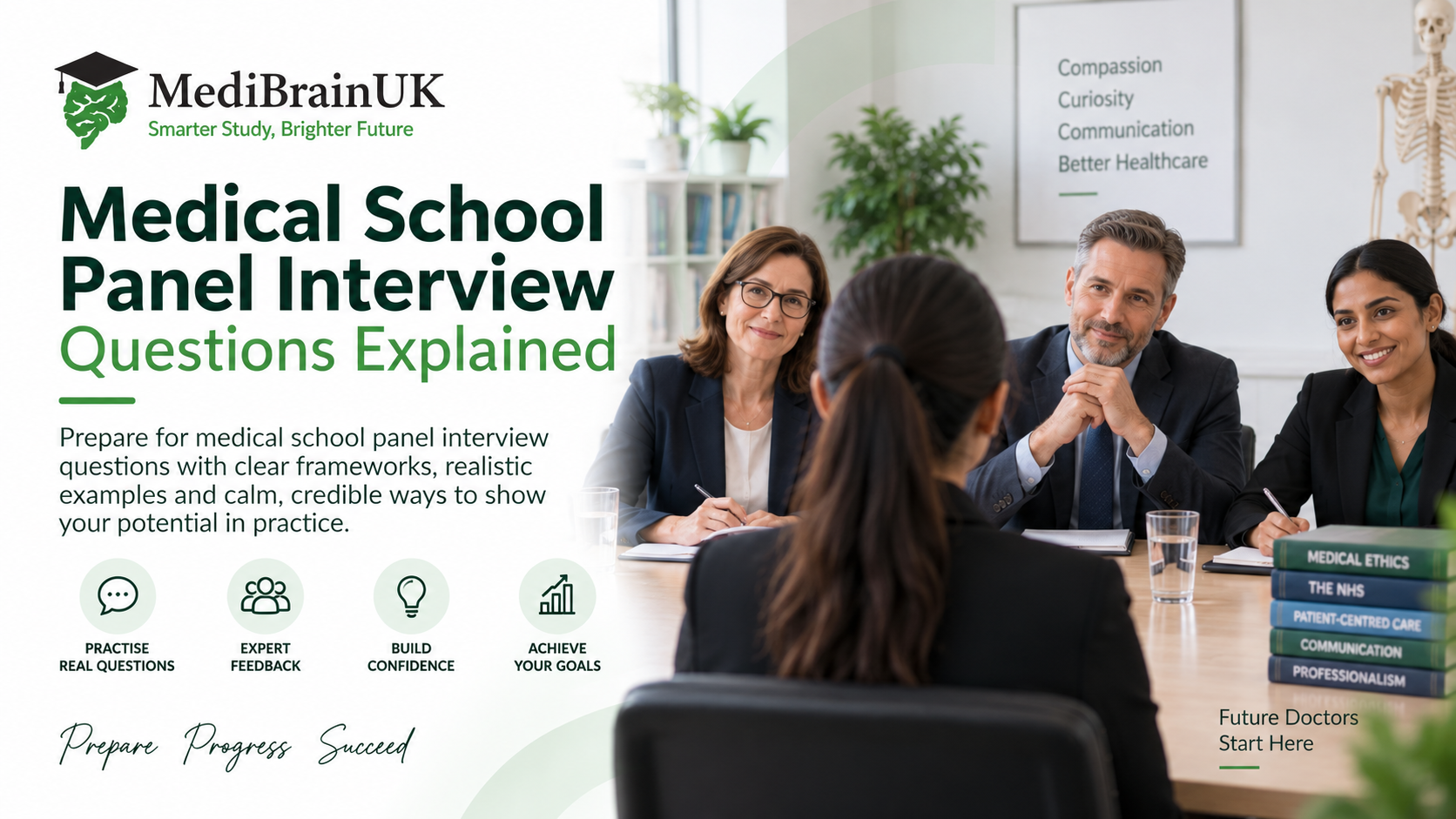
A medical school panel interview can feel more exposing than an MMI. Instead of resetting after each station, you may spend 20 minutes or more with the same interviewers while they explore your motivation, judgement, communication and understanding of Medicine in greater depth.
The good news is that medical school panel interview questions are rarely designed simply to catch you out. They are usually intended to test whether your motivation, reflection and understanding of the profession can stand up to a thoughtful conversation.
A strong panel interview is not about sounding like a textbook or delivering a speech you have memorised. It is about showing that you have reflected seriously on Medicine, can consider different perspectives, communicate with maturity and respond calmly when the panel asks you to go deeper.
With the right preparation, a panel interview becomes less about predicting every question and more about developing answers that are clear, credible and adaptable.
What does a medical school panel interview assess?
Each university sets its own interview format.
One panel might include an academic, clinician and current medical student. Another may use trained admissions staff or lay interviewers. Some medical schools ask broad questions about your application, while others include ethical scenarios, NHS discussion, work-experience reflection or follow-up questions based on something you have just said.
The exact format varies, but many assessment areas are similar.
Panels may explore:
- motivation for Medicine
- understanding of the doctor's role
- communication skills
- ethical awareness
- teamwork
- resilience
- reflection
- NHS awareness
- professionalism
- ability to recognise your limits
- ability to respond to follow-up questions
They are also looking for consistency.
Your application, work experience reflections and interview answers should tell the same honest story.
This is why generic answers can be risky.
Saying that you want to become a doctor because you “want to help people” may be sincere, but the panel is likely to ask what that means in practice.
They want to hear what you have observed, what you have learnt and how those experiences have developed your understanding of Medicine.
Common medical school panel interview questions
Although no applicant can predict every question, certain themes appear repeatedly in panel interviews.
The most useful preparation is not memorising model answers. It is developing a clear way of approaching each question type.
Why do you want to study Medicine?
This is one of the most important medical school interview questions because it allows the panel to explore whether your motivation is informed, realistic and personal.
Avoid presenting one dramatic moment as though it instantly decided your career.
Medicine is complex and demanding. A more credible answer often shows how your interest developed over time.
You could build your response around two or three connected areas, for example:
- an academic interest in human biology or disease
- work experience that showed you the importance of communication
- volunteering that helped you understand responsibility or teamwork
- further research into the realities of medical training
- experiences that strengthened your interest in patient-centred care
The aim is to show progression.
Explain not only what happened, but how it changed your understanding of Medicine.
You should also be prepared to explain why Medicine suits you more specifically than another healthcare profession.
Do this respectfully.
You can recognise the expertise of nurses, pharmacists, physiotherapists and other professionals while explaining what attracts you to the doctor's role in areas such as diagnosis, clinical decision-making, managing uncertainty and contributing to multidisciplinary care.
What did you learn from work experience or volunteering?
Medical schools are usually more interested in reflection than prestige.
A short placement can be useful if you have thought carefully about what it taught you.
Choose one or two focused examples.
For instance, you may have observed:
- a clinician adapting language for an anxious patient
- a healthcare assistant preserving dignity during personal care
- a team managing competing priorities
- how administrative pressures affect a patient's journey
- how professionals communicate across different roles
Describe the event briefly.
Then spend more time explaining the lesson.
What did it teach you about compassion, confidentiality, teamwork, communication, professionalism or patient-centred care?
Avoid exaggerating your role.
If you were observing, say so.
Thoughtful observation is much more credible than trying to make limited experience sound dramatic.
What qualities make a good doctor?
This question can sound simple, but strong answers usually go beyond listing qualities.
You could discuss areas such as:
- communication
- integrity
- empathy
- scientific curiosity
- resilience
- adaptability
- teamwork
- professionalism
The important part is explaining why each quality matters in patient care.
For example, communication is not simply speaking clearly.
It includes listening, checking understanding, adapting language and giving patients space to ask questions.
Integrity is not simply being honest.
It also includes raising concerns appropriately, acknowledging mistakes and recognising when you need advice or senior support.
Choose two or three qualities and explore them properly.
If appropriate, connect one of them to an example from school, volunteering, work, sport or another responsibility.
Tell us about an ethical issue in healthcare
Ethical questions are common in both panel interviews and MMIs.
You do not need a rehearsed answer for every possible healthcare scenario.
The panel is usually assessing your reasoning rather than your ability to recite terminology.
A useful approach is to consider:
- the people involved
- the key ethical issue
- capacity and consent where relevant
- confidentiality
- safeguarding
- possible benefits and harms
- patient safety
- professional responsibilities
- when advice or escalation would be appropriate
For example, if a patient refuses treatment, it would be sensible to explore capacity and whether the patient understands the relevant information.
You might then consider autonomy, potential harms and benefits, and the importance of communicating clearly.
Complex situations may require senior support, multidisciplinary discussion and professional or legal guidance.
Avoid absolute statements such as:
“Doctors should always do what the family wants.”
or:
“Doctors must always do whatever the patient says.”
The details of the scenario matter.
Ethical reasoning is rarely about finding a simple slogan.
What challenges is the NHS facing?
This question tests awareness and judgement rather than your ability to memorise statistics.
Choose a challenge you genuinely understand.
This could include:
- waiting lists
- workforce pressures
- staff retention
- health inequalities
- an ageing population
- pressure on primary care
- prevention and public health
- access to services
Explain the issue in terms of patients and staff.
For example, if discussing health inequalities, you could explore how deprivation, language barriers, digital exclusion and access to healthcare can influence outcomes.
You could then discuss possible approaches such as prevention, community support, improved access and culturally appropriate communication.
Keep your tone measured.
Avoid presenting one policy as though it could solve a complex national problem.
Panels usually respond better to applicants who demonstrate awareness of complexity.
How to structure panel interview answers without sounding rehearsed
A useful panel answer should have a clear beginning, middle and end.
Start by answering the question directly.
Develop your reasoning with an example, explanation or relevant context.
Finish by returning to what you learnt, what you believe or why the point matters for Medicine.
For experience-based questions, a simple structure can help:
Situation → Action → Reflection
The reflection should usually receive the greatest emphasis.
For ethical or policy questions, you might use:
Issue → Perspectives → Balanced judgement → Appropriate next step
These frameworks are useful because they help you stay focused.
They should not become scripts.
Why follow-up questions matter in panel interviews
One of the biggest differences between a panel interview and an MMI is the depth of follow-up.
A panel may challenge something you have just said.
They may ask:
“Why?”
“What makes you think that?”
“Can you give me an example?”
“What would you do differently?”
“How does that relate to Medicine?”
This is not necessarily a sign that your first answer was weak.
The panel may simply want to test how deeply you have thought about the issue.
Pause before responding.
You do not need to answer instantly.
If you do not know a fact, avoid bluffing.
It is often more credible to acknowledge uncertainty and explain how you would seek reliable information or appropriate support.
That can demonstrate safer judgement than guessing confidently.
Preparation that translates into panel interview performance
Begin by researching the specific medical school.
Read the course structure, admissions information and stated values.
If a medical school emphasises community placements, research, early clinical exposure or another distinctive feature, understand why that approach appeals to you.
Do not force university-specific details into every answer.
Use them when they genuinely support your reasons for applying.
Next, build a small bank of personal experiences.
These might come from:
- volunteering
- work experience
- team activities
- academic challenges
- leadership
- part-time employment
- mistakes
- receiving feedback
- responsibilities at home or school
For each experience, write down:
- what happened
- what you did
- what you learnt
- how it relates to Medicine
This gives you adaptable evidence without forcing you to memorise every answer word for word.
Then practise aloud.
Silent preparation can help you organise your ideas, but it does not reveal how you actually sound under pressure.
Recording yourself can reveal:
- rushed delivery
- long answers
- repeated phrases
- weak eye contact
- excessive filler words
- answers that take too long to reach the main point
Practising with someone who is willing to ask follow-up questions is particularly valuable.
Why realistic mock panel interviews matter
A panel interview is not simply a test of knowledge.
It is also a test of how you communicate while being observed for an extended period.
This can feel very different from answering questions alone.
A realistic mock panel can help you practise:
- answering unfamiliar questions
- maintaining eye contact
- responding to multiple interviewers
- handling follow-up questions
- thinking before speaking
- recovering after an imperfect answer
- managing your pace
- staying composed throughout the interview
At MediBrain UK, Medical Interview Preparation focuses on this gap between knowing what you want to say and being able to deliver it clearly under interview conditions.
Structured question practice, live feedback and repeat opportunities can help applicants improve the clarity, depth and credibility of their answers.
Panel interview confidence is different from memorising answers
Some applicants try to become more confident by preparing more scripts.
This can have the opposite effect.
If you are concentrating on remembering exact wording, a follow-up question can quickly disrupt your flow.
Confidence in a panel interview comes from understanding your own experiences, having reliable answer structures and knowing that you can respond even when the conversation moves in an unexpected direction.
That is where Pre-Interview Confidence Coaching can also be valuable.
Interview nerves can affect:
- speaking pace
- eye contact
- posture
- voice control
- answer structure
- ability to recover after a difficult question
- willingness to pause before responding
Confidence coaching is not about teaching applicants to behave artificially.
It is about helping them communicate naturally and effectively when pressure increases.
For a panel interview, this is especially important because you remain in the same conversation for longer and cannot simply reset with a new assessor after each question.
Mistakes that weaken otherwise strong applicants
One of the most common mistakes is over-rehearsal.
A polished opening can be useful, but an answer that sounds identical to an online model response often becomes vague and inflexible.
Use frameworks to support your thinking, not replace it.
Another mistake is confusing description with reflection.
Saying that a doctor was “inspirational” tells the panel very little.
Explain what the doctor did, why it mattered and what it taught you.
Applicants can also weaken their answers by speaking for too long.
A panel interview is a conversation.
Leave space for the interviewer to respond and ask follow-up questions.
Another common problem is becoming defensive when challenged.
A follow-up question is not necessarily criticism.
Listen carefully, consider the point and respond calmly.
Finally, do not panic if one answer is imperfect.
Interviewers are assessing potential, not expecting a finished doctor.
Correct yourself where necessary, acknowledge complexity and keep communicating.
The ability to recover calmly can demonstrate maturity in itself.
Prepare for a medical school panel interview with MediBrain UK
If you want more structured support, the MediBrain UK Medical Interview Preparation Programme supports applicants preparing for both panel interviews and MMIs.
Preparation can include areas such as:
- motivation for Medicine or Dentistry
- work-experience reflection
- medical ethics
- NHS topics
- communication
- role-play
- panel interview questions
- follow-up questioning
- university-specific preparation
- realistic mock interviews
- detailed feedback
Depending on the programme package, applicants can also access Pre-Interview Confidence Coaching, mentoring and university-specific mock interview preparation.
This combination can be particularly useful for panel interviews.
Knowledge gives you something meaningful to say.
Practice helps you communicate it.
Feedback shows you what needs refinement.
Confidence coaching helps you deliver your answers more calmly when the conversation becomes challenging.
You can explore the available support on the MediBrain UK Medical Interview Preparation page.
Final thoughts
Your task is not to predict every question on the panel's sheet.
It is to become clear about:
- why Medicine is right for you
- what you have learnt from your experiences
- how you approach ethical and professional issues
- how you respond to uncertainty
- how you communicate when challenged
That preparation gives you something more useful than a memorised answer.
It gives you control when the conversation becomes difficult.
A strong medical school panel interview is not about perfection. It is about showing the panel that you can think clearly, reflect honestly, communicate respectfully and respond with maturity when they ask you to go deeper.