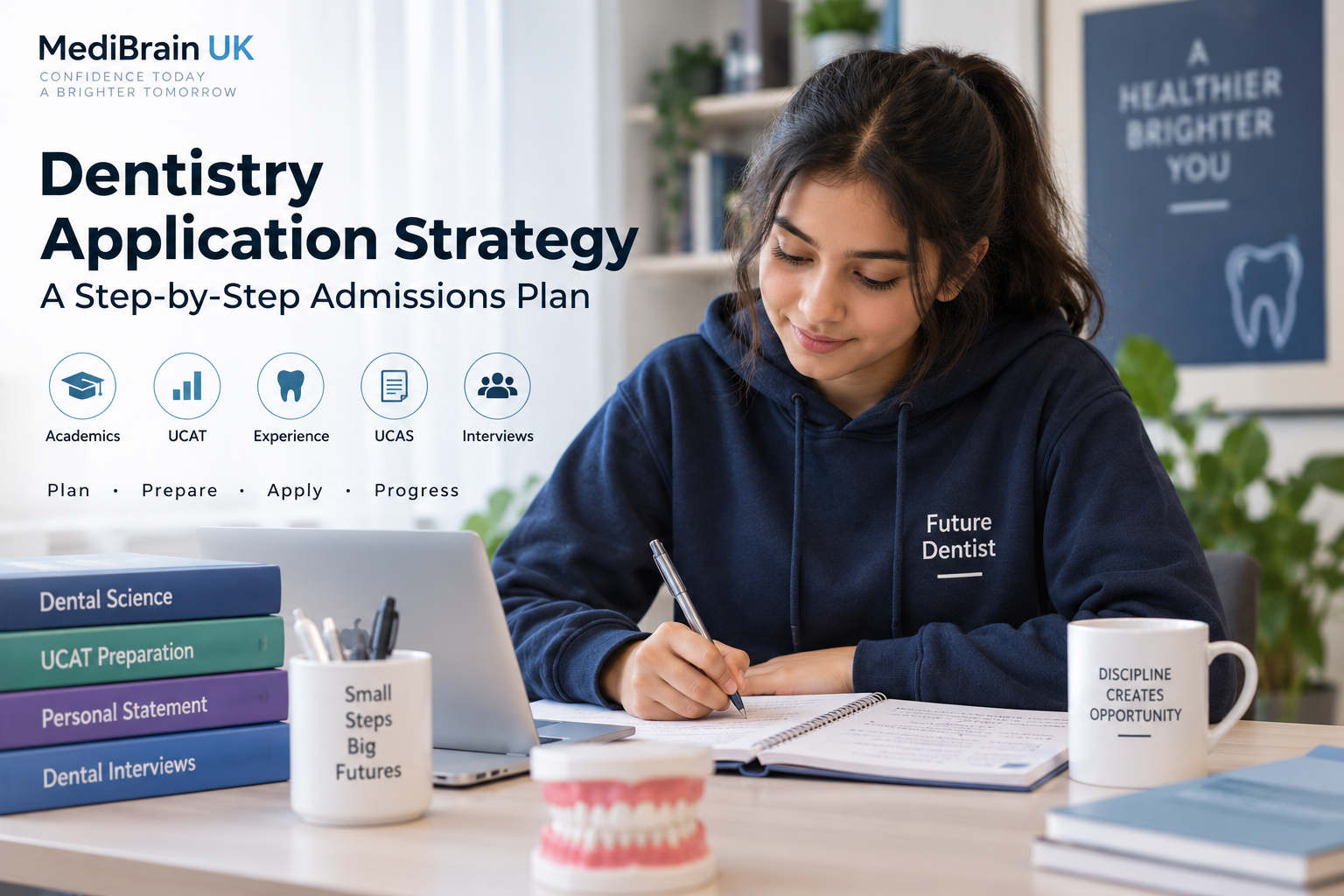
Applying for dentistry is about much more than achieving strong grades. A successful dentistry application brings together academic performance, UCAT preparation, meaningful experience, carefully chosen dental schools, strong UCAS answers and confident interview preparation.
The strongest applicants approach these elements as part of one strategy rather than treating them as separate hurdles. Your grades influence where you can apply, your UCAT score can reshape your shortlist, your experiences provide evidence for UCAS and interviews, and your final university choices determine how effectively you use your application.
This step-by-step dentistry application plan explains how to build each part of your application, from strengthening your academic profile and preparing for the UCAT to choosing dental schools strategically and preparing for interviews.
What Dental Schools Look for in a Strong Application
Dental schools want evidence that you can succeed on a demanding science-based degree, but academic achievement is only one part of the application.
Your GCSEs, predicted grades and A-Level subjects establish your academic readiness. Chemistry and Biology are commonly required, while individual dental schools may have different requirements for GCSE subjects, grades, additional qualifications and contextual applicants.
Always check the current entry requirements for every dental school you are considering before applying.
Beyond academic performance, your application needs to demonstrate an informed understanding of dentistry. Admissions teams are looking for applicants who appreciate that dentistry combines scientific knowledge, clinical precision, communication, professionalism and responsibility for patient care.
A convincing motivation for dentistry therefore needs to go further than enjoying science or wanting a practical healthcare career. You should understand the importance of prevention, teamwork, consent, patient trust and communicating with people who may be anxious or vulnerable.
Build Your Academic Profile Early
Strong predicted grades keep more dental schools available to you and give you the best chance of meeting an eventual offer.
Rather than waiting until Year 13 to address weaknesses, use Year 12 or the equivalent stage of your studies to identify topics that are consistently costing you marks.
For example, instead of setting a general target to “improve Chemistry”, identify whether calculations, organic mechanisms, practical questions or a particular topic are causing problems. Your revision can then become much more targeted.
The same principle applies to Biology. Large amounts of content need to be understood, recalled and applied accurately to unfamiliar questions.
Regular retrieval practice, exam questions and feedback are generally more useful than repeatedly reading notes without testing whether you can apply the knowledge.
Academic preparation is not separate from your dentistry application strategy. Your predicted and achieved grades directly influence which dental schools may be realistic choices.
Develop a Deliberate UCAT Strategy
For many dentistry applicants, the UCAT is one of the most important variables in deciding where to apply.
Strong academic results do not automatically guarantee a strong UCAT score. The examination places significant pressure on speed, decision-making and accuracy.
Begin by understanding the format and completing a diagnostic assessment under realistic conditions. This gives you a baseline and helps identify which areas require the most attention.
Your preparation can then become targeted.
Verbal Reasoning may require you to become faster at locating relevant evidence rather than reading every passage in full. Decision Making requires careful logical reasoning. Quantitative Reasoning rewards efficient calculation, number selection and calculator fluency. Situational Judgement requires you to consider professional behaviour, patient safety and appropriate responses.
Avoid measuring preparation only by the number of questions completed. Large volumes of practice can build familiarity, but they are less valuable if you repeatedly make the same mistakes.
Use targeted timed practice to improve specific weaknesses, review errors carefully and introduce full mocks as your preparation develops.
Different dental schools can use UCAT results differently, which means your score becomes particularly important when you start building your final university shortlist.
Use Your UCAT Score to Choose Dental Schools Strategically
One of the biggest application mistakes is deciding on four dental schools before properly considering how each university assesses applicants.
Your shortlist should be built around your actual application profile rather than reputation, league tables or where you originally hoped to study.
Once you have your UCAT result, review your complete profile:
- GCSE results
- predicted or achieved A-Level grades
- UCAT performance
- contextual eligibility, where applicable
- relevant experience and preparation
- individual dental school entry requirements
- how each dental school selects candidates for interview
The aim is not simply to find dental schools whose minimum entry requirements you meet. Meeting the minimum requirements does not necessarily mean you have a competitive application for interview.
Look at how each dental school uses the UCAT and academic results during selection. Where reliable historical information is available, it can provide useful context, but previous thresholds should never be treated as guaranteed future cut-offs.
This is where strategic application choices become important.
If your UCAT is a relative strength, universities that place greater emphasis on UCAT performance may deserve closer consideration. If your academic profile is particularly strong, you may want to investigate dental schools where academic achievement carries greater weight.
Contextual applicants should also check each university's eligibility criteria carefully because contextual admissions policies can affect entry requirements or how an application is considered.
The strongest shortlist is therefore personal. A dental school that is an excellent strategic choice for one applicant may be a poor choice for another applicant with different GCSEs, predicted grades or UCAT performance.
Before submitting UCAS, you should be able to explain why each of your dental school choices fits your individual profile.
Turn Work Experience Into Evidence of Insight
Work experience can help you understand dentistry, but simply completing a placement is not enough.
What matters is what you observed, what you learned and how thoughtfully you can reflect on the experience.
If you have observed in a dental practice, consider what happened beyond the clinical procedure itself.
How did the dentist explain treatment options to a nervous patient? How did the dental nurse contribute to patient safety and reassurance? What did you learn about infection control, confidentiality, consent or communication?
These observations can demonstrate a much deeper understanding of dentistry than simply stating that you shadowed a dentist.
Access to dental work experience can vary. Other experiences may also help you develop relevant qualities when reflected on appropriately. Volunteering, care environments, tutoring, employment and other positions of responsibility may provide evidence of communication, teamwork, reliability and the ability to support others.
Avoid forcing every activity into the statement that it “confirmed your passion for dentistry”.
Instead, ask:
What did I observe?
What did I learn?
How did it change or strengthen my understanding of dentistry?
What skill or professional value did it help me appreciate?
Keeping a simple reflection record throughout your preparation can give you useful, authentic material for both your UCAS application and dental interviews.
Write Strong UCAS Answers With a Clear Purpose
The UCAS three-question personal statement format gives you an opportunity to present different aspects of your preparation while building one coherent case for dentistry.
Your answers should demonstrate informed motivation, academic preparation and relevant experiences or activities.
Avoid turning the application into a catalogue of achievements.
Listing placements, books, courses and awards tells an admissions team what you have done. Reflection helps them understand what you learned from those experiences and why they matter.
A useful approach is to repeatedly ask three questions:
What did I do?
What did I learn?
Why does this matter for dentistry?
For example, observing communication between a dentist and an anxious patient becomes much more meaningful when you explain what it taught you about trust, clear explanations and adapting communication to individual patients.
Start drafting early enough to revise properly. Editing should remove repetition, generic statements and unnecessary language while making your reasoning clearer.
Your UCAS answers should also remain authentic. Anything you submit may provide material for discussion later in the admissions process.
Prepare for Dental Interviews Before Invitations Arrive
Do not wait for an interview invitation before beginning your preparation.
Dental interviews may use MMI, panel or other formats and can assess much more than your ability to deliver polished answers.
Potential areas include:
- motivation for dentistry
- communication
- ethics
- professionalism
- teamwork
- consent and confidentiality
- safeguarding
- understanding of dentistry
- NHS and healthcare awareness
- manual skills
- reflection on experience
- handling difficult or unfamiliar situations
The objective should not be to memorise perfect model answers.
Memorised responses can quickly become difficult to maintain when an interviewer asks an unexpected follow-up question. Understanding the principles behind an issue allows you to adapt.
For MMI preparation, practise responding to realistic stations within a time limit. Identify the issue, organise your reasoning and communicate your answer clearly.
For panel interviews, practise having a professional conversation rather than delivering a rehearsed speech.
Recording occasional answers can help identify habits such as speaking too quickly, avoiding the question or using repetitive phrases. Live practice and feedback can also help you understand how your answers are received by another person.
Interview confidence does not mean eliminating nerves. It means developing enough structure and practice to think clearly despite them.
Build a Dentistry Application Timeline
A strong dentistry application is easier to manage when preparation is spread across the admissions cycle.
Year 12: Build the Foundation
Prioritise your academic performance while beginning to explore dentistry meaningfully.
Research the profession, seek appropriate experience where possible and keep reflections on what you learn.
You can also begin familiarising yourself with the UCAT so that the examination format is not completely unfamiliar when focused preparation starts.
UCAT Preparation Period: Build and Test Your Technique
Establish your baseline, identify weaker areas and move towards increasingly timed practice.
Use mocks to assess progress rather than simply collecting scores. Review why mistakes happened and adjust your strategy accordingly.
After Your UCAT: Reassess Your Dental School Choices
This is a critical stage.
Compare your final UCAT result and academic profile with the selection methods and current entry requirements of the dental schools you are considering.
Do not remain committed to an original shortlist if your results suggest that different choices would give you a stronger application strategy.
Before the UCAS Deadline: Finalise Your Application
Check every course carefully.
Confirm that you meet academic and subject requirements, investigate contextual criteria where relevant, complete your UCAS answers and make sure your final dental school choices reflect your actual profile.
Interview Season: Convert the Application Into an Offer
Once applications have been submitted, shift towards interview preparation.
Develop your understanding of professional and ethical issues, review your experiences, practise communicating under time pressure and research the interview format used by each dental school.
Reapplying to Dentistry
An unsuccessful application does not automatically mean dentistry is no longer realistic.
However, a reapplication should address what prevented the previous application from progressing.
Review each stage objectively.
Was your UCAT score limiting your university choices?
Did your academic profile restrict where you could apply?
Was your shortlist too ambitious?
Did you receive interviews but no offers?
Did your interview preparation begin too late?
The answer determines where your effort should go.
A productive gap year or reapplication cycle should demonstrate development rather than simply repeating the same application with another year added to it.
Final Dentistry Application Checklist
Before submitting your application, make sure you can answer these questions confidently:
- Do I meet the current academic requirements for every dental school I have selected?
- Have I considered how each dental school uses the UCAT?
- Does my shortlist reflect my actual academic and UCAT profile?
- Have I checked whether I qualify for contextual consideration?
- Can I explain clearly why I want to study dentistry?
- Can I reflect meaningfully on my experiences?
- Are my UCAS answers specific, authentic and relevant?
- Have I started preparing for interviews rather than waiting for an invitation?
- Can I explain why each of my dental school choices is strategically appropriate for me?
If the answer to any of these is unclear, address it before submitting your application.
Build an Application Strategy Around Your Profile
There is no single perfect dentistry application strategy because applicants do not have identical academic results, UCAT scores, experiences or circumstances.
The objective is to understand your own profile and make informed decisions at every stage.
Strong grades create options. Focused UCAT preparation can strengthen those options. Meaningful reflection gives depth to your application. Strategic dental school choices improve how effectively you use your UCAS choices. Interview preparation gives you the opportunity to convert an invitation into an offer.
At MediBrain UK, our application support helps students bring these stages together, from UCAT preparation and strategic university selection to UCAS guidance and interview preparation.
Start early, review your progress honestly and be prepared to adapt your strategy as your results become clearer. A strong dentistry application is not built from one outstanding component. It is built by making well-informed decisions throughout the entire admissions process.