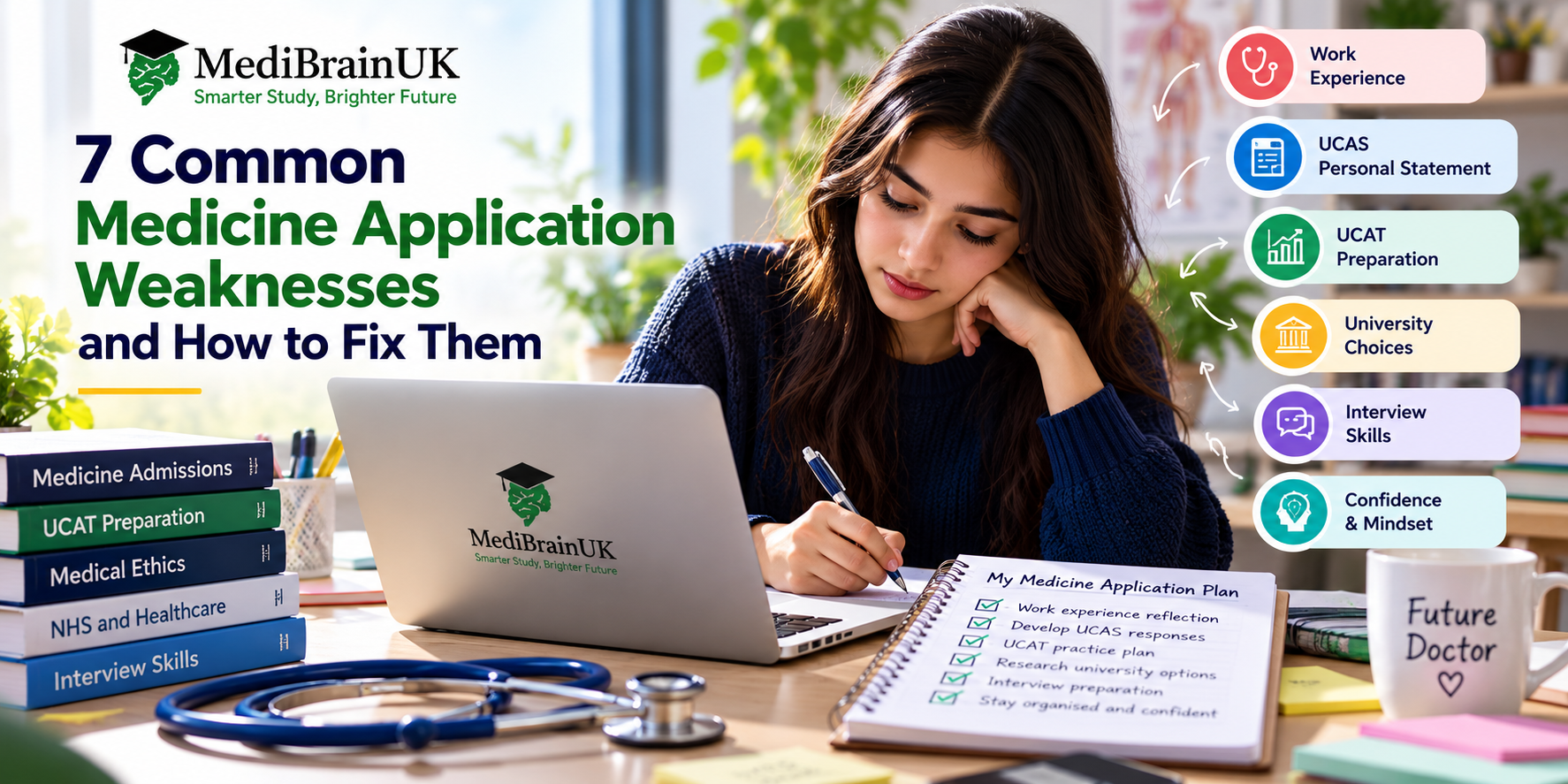
Applying to medical school in the UK requires more than excellent grades, an impressive UCAT score or a long list of extracurricular activities. A successful application depends on how well you understand the profession, demonstrate your suitability and make informed decisions throughout the admissions process.
Many capable applicants unintentionally weaken their chances through avoidable mistakes. They may have valuable work experience but struggle to reflect on it, achieve strong academic results but choose unsuitable universities, or prepare extensively for interviews without developing the confidence to answer unfamiliar questions.
The good news is that many of these weaknesses can be addressed through careful preparation, honest self-assessment and targeted feedback.
This guide explores seven common Medicine application weaknesses, explains why they matter and provides practical strategies to strengthen your application for UK medical schools.
What are the most common weaknesses in a Medicine application?
The seven weaknesses worth addressing are:
- Describing work experience without meaningful reflection.
- Giving generic or unconvincing reasons for studying Medicine.
- Underestimating the UCAT and choosing universities without a clear strategy.
- Writing repetitive or poorly structured UCAS personal statement responses.
- Listing activities without demonstrating relevant personal qualities.
- Memorising interview answers instead of developing flexible communication skills.
- Leaving preparation too late and allowing pressure to affect performance.
Not every weakness will affect every applicant equally. The important task is to identify which aspects of your application need attention and improve them before they influence an admissions decision.
1. Describing work experience without meaningful reflection
Work experience is valuable, but simply completing a placement does not automatically make an application stronger.
One of the most common mistakes is treating work experience as a record of activities rather than an opportunity to demonstrate insight into healthcare.
An applicant might write:
"During my hospital placement, I observed doctors communicating with patients, attended ward rounds and learned about different medical conditions."
This describes what happened, but it tells an admissions tutor very little about what the applicant understood.
Why this weakens your application
Medical schools want applicants to develop a realistic understanding of healthcare, including the importance of communication, teamwork, compassion, professionalism and responsibility.
A student who can explain the significance of a relatively simple interaction may demonstrate more insight than someone who lists several impressive placements without reflecting on them.
How to fix it
Use a reflection framework built around three questions:
- What did I observe or experience? Identify a specific situation without disclosing confidential information.
- What did it teach me? Explain the professional qualities, challenges or responsibilities you recognised.
- How did it influence my understanding? Consider how the experience shaped your motivation or future development.
For example:
"While volunteering in a care setting, I noticed how taking time to listen helped a resident feel more comfortable expressing their concerns. This helped me appreciate that effective communication is not simply about explaining information clearly, but also about creating an environment in which someone feels heard and respected."
This is more convincing because the applicant explains the significance of the experience rather than merely describing it.
Practical improvement
After every placement, volunteering session or relevant activity, record one meaningful observation and your reflection on it.
You do not need to manufacture a dramatic experience. Everyday interactions can reveal important lessons about dignity, empathy, patient-centred care and teamwork.
Key lesson: The value of work experience lies in what you learn from it, not simply where you complete it.
2. Giving generic reasons for wanting to study Medicine
When applicants are asked why they want to become doctors, common answers include:
"I have always wanted to help people."
"I enjoy Biology and Chemistry."
"Medicine is a rewarding career."
These reasons may be genuine, but they are not sufficiently developed on their own.
Why this weakens your application
Admissions tutors need to understand why you have chosen Medicine specifically, rather than another scientific or healthcare profession.
An interest in science is relevant, but studying Medicine also involves responsibility for patients, communicating difficult information, managing uncertainty and working within multidisciplinary teams.
Similarly, wanting to help people is admirable, but applicants should demonstrate an understanding of how doctors contribute to patient care.
How to fix it
Build your motivation around three connected elements:
Personal motivation
Explain what first interested you in Medicine and why that interest developed.
Informed exploration
Demonstrate how work experience, volunteering, reading, discussions or independent research helped you understand the profession.
Realistic understanding
Acknowledge that Medicine involves challenges as well as rewards, including demanding workloads, difficult decisions, emotional situations and lifelong learning.
A stronger response might be:
"My interest in Medicine developed through studying human physiology, but volunteering helped me recognise that scientific knowledge is only one part of effective patient care. I became particularly interested in how doctors combine clinical reasoning with communication and empathy when supporting people through uncertainty."
This response connects academic interest with practical understanding.
Practical improvement
Try answering the question:
Why Medicine, rather than another healthcare profession?
You do not need to criticise other careers. Instead, explain which responsibilities and characteristics of being a doctor particularly appeal to you.
A convincing answer should be personal, informed and grounded in a realistic understanding of the profession.
3. Underestimating the UCAT and choosing universities without a clear strategy
Strong GCSEs and predicted A-Level grades are important, but they do not automatically make every medical school a suitable choice.
Medical schools use academic qualifications, UCAT performance, contextual information and other selection criteria differently.
An applicant may meet the published academic requirements for a university but still be less competitive at the shortlisting stage.
Why this weakens your application
The UCAT is an important component of selection at many UK medical schools.
A common mistake is assuming that meeting the minimum entry requirements means having a strong chance of receiving an interview.
Another is applying to universities based mainly on reputation, location or league-table rankings without understanding how applicants are shortlisted.
A university that is suitable for one academically strong student may be a much less favourable choice for another.
How to fix it
Prepare for the UCAT systematically
Effective UCAT preparation should involve more than completing large numbers of questions.
Begin by understanding the assessment format and identifying where you lose marks.
The current UCAT includes Verbal Reasoning, Decision Making, Quantitative Reasoning and Situational Judgement.
Use a structured approach:
- Learn the question types and methods for each subtest.
- Build accuracy before increasing speed.
- Introduce timed practice progressively.
- Review errors to identify recurring weaknesses.
- Complete realistic mock tests and use the results to adjust your preparation.
For example, if you regularly spend too long interpreting numerical tables, the solution may involve improving estimation, data selection and time-management techniques rather than simply practising more calculations.
MediBrain UK's UCAT preparation resources, including its question bank and mock practice tools, can be used alongside official UCAT resources to support more structured revision.
Choose medical schools strategically
Once you have your UCAT result, examine how each university assesses applicants. Our guide to Choosing Medical Schools: Build a Smarter UCAS List explains how to approach this comparison.
Consider:
- GCSE subject and grade requirements.
- Predicted or achieved A-Level qualifications.
- UCAT score and Situational Judgement requirements.
- Contextual admissions criteria.
- Selection and interview shortlisting policies.
- Eligibility for your specific applicant route.
For example, two students with similar UCAT scores may have different university options because of differences in their GCSE profiles, predicted grades or contextual eligibility.
MediBrain UK's ApplySmart has been developed to help applicants bring these factors together. Its planned features include personalised eligibility information, university comparisons, applicant-profile analysis and a dashboard for managing potential choices.
Rather than treating a UCAT score as an isolated number, applicants can use this type of structured comparison to make better-informed decisions. ApplySmart is currently preparing for launch, so students should continue checking official university admissions information directly.
Key lesson: A strong application is not simply about achieving the highest possible grades. It is also about applying where your overall profile is competitive.
4. Writing repetitive or poorly structured UCAS personal statement responses
The UCAS personal statement format uses three structured questions, giving applicants the opportunity to explain their motivation, academic preparation and experiences beyond formal education.
However, a clearer structure does not automatically produce a stronger application.
One common mistake is repeating the same experience across several answers without adding anything new.
Why this weakens your application
A personal statement should help admissions teams understand different aspects of your preparation.
If each answer repeats similar claims about communication, teamwork and motivation, the overall application may lack depth.
Another weakness is using impressive-sounding language without supporting it with evidence.
For example:
"I possess exceptional leadership, communication and problem-solving skills."
This statement makes several claims but provides no reason for an admissions tutor to believe them.
How to fix it
Give each UCAS question a clear purpose.
Question 1: Why do you want to study this course or subject?
Focus on your motivation for Medicine and how you have developed an informed understanding of the profession.
Explain why the subject interests you and what you have done to explore it.
Question 2: How have your qualifications and studies helped you prepare?
Discuss relevant academic learning, intellectual curiosity and your ability to engage with demanding scientific material.
You might explain how studying a particular topic led you to explore medical research, human physiology or the application of science in healthcare.
Question 3: What else have you done to prepare outside education, and why are these experiences useful?
Use relevant work experience, volunteering, employment, caring responsibilities, extracurricular activities or independent exploration.
Explain what these experiences taught you and how they relate to studying Medicine.
Practical improvement
Before drafting, create an evidence bank containing your experiences, learning points and examples.
Assign each experience to the question where it adds the greatest value.
An experience can be mentioned more than once when there is a genuine reason, but avoid repeating the same explanation.
Once you have drafted your answers, ask yourself:
Does every paragraph reveal something meaningful about my motivation, preparation or suitability?
Remember that the UCAS personal statement is a shared application document. Your responses should remain accurate, personal and authentically your own.
5. Listing activities without demonstrating relevant personal qualities
Many applicants participate in worthwhile activities such as volunteering, mentoring, sport, student leadership or part-time employment.
The difficulty arises when they assume that holding a position automatically proves they possess a particular skill.
For example:
"Being a prefect improved my leadership and communication skills."
This may be true, but it lacks evidence.
Why this weakens your application
Medical schools are interested in qualities such as teamwork, integrity, empathy, resilience, communication and self-awareness.
Simply naming these qualities does not demonstrate them.
Admissions tutors need to understand how you behaved in real situations and what you learned from the experience.
How to fix it
Use a simple evidence-based structure:
Situation → Action → Outcome → Reflection
Consider a student who helped organise a school event.
A weak explanation might be:
"I developed teamwork skills while organising a school event."
A stronger explanation would be:
"When organising a school event, our team disagreed about how to allocate responsibilities. I suggested dividing tasks according to each person's strengths and checking progress regularly. This helped us complete the preparations on time and taught me the importance of listening, flexibility and shared responsibility."
The second response provides evidence of teamwork rather than merely claiming it.
Practical improvement
Identify four or five genuine experiences that demonstrate different qualities.
For each experience, consider:
- What challenge or responsibility did I face?
- What did I personally contribute?
- What was the outcome?
- What did I learn?
- What might I do differently next time?
Be prepared to discuss limitations as well as successes.
Recognising that you could have handled a situation better can demonstrate maturity and self-awareness.
Key lesson: Medical schools do not need applicants who claim to be perfect. They need applicants who can learn, reflect and develop.
6. Memorising interview answers instead of developing flexible communication skills
Medical school interviews assess more than your ability to recall prepared information.
Whether you attend a Multiple Mini Interview (MMI) or a panel interview, you may be asked to respond to unfamiliar situations, explore ethical dilemmas, discuss personal experiences or explain your reasoning.
One of the biggest preparation mistakes is attempting to memorise complete answers.
Why this weakens your application
Memorised responses can sound unnatural and may become difficult to adapt when an interviewer asks an unexpected follow-up question.
An applicant might prepare an excellent answer about teamwork but struggle when asked:
"Can you describe a time when teamwork did not go well?"
The issue is not necessarily a lack of experience. It may be that the applicant has prepared a speech rather than developed the ability to reflect and respond.
How to fix it
Understand the purpose of each question
For motivation questions, focus on personal insight and realistic understanding.
For ethical scenarios, identify the relevant concerns, stakeholders and professional responsibilities before reaching a reasoned conclusion.
For communication stations, demonstrate active listening, empathy and an appropriate response to the other person's needs.
Practise frameworks, not scripts
A useful approach to an ethical scenario is to:
- Identify the central issue.
- Consider the people affected.
- Recognise relevant ethical and professional principles.
- Explain the possible options and their consequences.
- Reach a balanced, patient-centred response, recognising when further information or senior support is needed.
Your reasoning should be guided by professional standards, including relevant GMC guidance.
Practise under realistic conditions
Speaking aloud is very different from thinking through an answer silently.
Timed interview stations help you develop the ability to organise your thoughts, communicate clearly and recover when a question becomes challenging.
Feedback is especially valuable when it identifies specific behaviours.
For example:
"Your ethical reasoning was balanced, but you reached your conclusion before explaining the patient's perspective."
This is more useful than simply being told to improve your answer.
Confidence is part of effective preparation
Interview confidence is not about sounding rehearsed or speaking without hesitation.
It involves managing pressure, listening carefully, maintaining composure and communicating your reasoning even when you are uncertain.
MediBrain UK's Medical Interview Preparation Programme incorporates structured MMI and panel interview practice, ethical reasoning, communication exercises, mock interviews and personalised feedback.
Its confidence-focused preparation is intended to help students develop both interview technique and the ability to perform under pressure.
The objective of good interview coaching should be to strengthen independent thinking and authentic communication, not to provide applicants with answers to memorise.
Key lesson: Prepare your reasoning and your examples thoroughly, but leave room to think naturally during the interview.
7. Leaving preparation too late and allowing pressure to affect performance
Medicine applications involve several demanding stages, often alongside A-Level studies, examinations and other commitments.
A common weakness is concentrating heavily on one stage while neglecting another.
For example, a student may spend months preparing for the UCAT but leave university research until the final weeks before the UCAS deadline.
Another may complete the written application successfully but delay interview preparation until receiving an invitation.
Why this weakens your application
Late preparation reduces the time available for reflection, feedback and improvement.
It can also increase anxiety, making it harder to concentrate and evaluate decisions calmly.
The solution is not to work continuously or sacrifice rest. It is to build a realistic plan that gives each stage sufficient attention.
How to fix it
Plan backwards from important deadlines
Identify the key milestones in your application cycle:
- Academic preparation and predicted grades.
- Work experience and reflection.
- UCAT registration, preparation and testing.
- Medical school research and selection.
- UCAS application submission.
- MMI or panel interview preparation.
Check official dates each year rather than relying on previous application cycles.
Use weekly priorities
Instead of attempting to complete everything simultaneously, set manageable targets.
For example, one week might involve reviewing UCAT mistakes, completing a reflection entry and comparing the admissions policies of two universities.
A later week may focus on personal statement revisions and interview communication practice.
Seek feedback before problems become established
Feedback can be valuable at different stages of the process.
UCAT performance reviews can reveal weaknesses in accuracy or timing.
Application guidance can identify unsupported claims, poor reflection or unsuitable university choices.
Mock interviews can highlight communication habits that applicants may not recognise themselves.
Structured guidance, including MediBrain UK's admissions resources and preparation programmes, can help students identify areas for improvement. However, the most important factor is using that feedback consistently and taking responsibility for progress.
Protect your wellbeing
Effective preparation should include rest, sleep and time away from admissions work.
If anxiety is affecting concentration or daily functioning, speak with a trusted adult, teacher or appropriate healthcare professional rather than relying on additional practice alone.
Key lesson: Consistent preparation is usually more sustainable than repeated periods of last-minute intensive work.
How to identify the weakest part of your Medicine application
Before making major changes, review your application honestly.
| Application area | Question to ask yourself | Action to take |
|---|---|---|
| Work experience | Can I explain what I learned beyond describing activities? | Write two detailed reflections |
| Motivation | Can I explain why Medicine specifically appeals to me? | Develop an evidence-based answer |
| UCAT | Do I understand my recurring mistakes and timing difficulties? | Review practice performance |
| University selection | Have I checked how each university assesses my profile? | Compare official selection criteria |
| UCAS responses | Does each answer contribute distinct evidence? | Remove repetition and unsupported claims |
| Personal qualities | Can I demonstrate my skills with genuine examples? | Build an experience bank |
| Interviews | Can I respond clearly without relying on memorised scripts? | Practise unfamiliar timed questions |
This exercise is particularly useful because it shifts attention away from how much preparation you have completed and towards how effective that preparation has been.
How MediBrain UK can support a stronger application
Different applicants need support at different stages.
Some need to improve their UCAT technique. Others need to understand which medical schools are realistic choices. Students who have received interview invitations may benefit most from structured practice, feedback and confidence development.
MediBrain UK provides resources across these areas:
- UCAT preparation: Question practice, mock assessments and structured approaches to accuracy and timing.
- ApplySmart: A developing application strategy platform designed to compare university requirements against an applicant's academic and admissions profile.
- Admissions guidance: Practical articles and resources covering work experience, personal statements, university selection and application planning.
- Medical interview preparation: MMI and panel interview coaching, ethical scenarios, communication practice, confidence development and mock interview feedback.
These resources can support the preparation process, but they should complement independent research, authentic reflection and careful checking of official admissions requirements.
The aim is not to create an application that looks impressive on paper but to help students make informed decisions and demonstrate their genuine potential.
Frequently asked questions
What is the biggest weakness in a Medicine application?
There is no single weakness that affects every applicant equally. Common problems include insufficient reflection, poorly researched university choices, inadequate UCAT preparation and weak interview communication. The most significant weakness is often the one that directly affects how a particular university selects applicants.
Can excellent GCSEs and A-Level grades compensate for a low UCAT score?
Not necessarily. Universities use the UCAT differently, and some apply thresholds or ranking systems that make UCAT performance particularly important. Applicants should review the published admissions criteria for each university rather than assume that excellent grades will compensate for a weaker test result.
How can I make my Medicine application stand out?
Focus on meaningful evidence rather than attempting to appear exceptional in every area. Demonstrate informed motivation, thoughtful reflection, academic readiness, professional awareness and the ability to learn from experience.
Is hospital work experience essential for Medicine?
Not every medical school requires hospital shadowing. Relevant experience may include volunteering, caring responsibilities, community activities or other opportunities that develop an understanding of people, responsibility and healthcare-related skills. Always check individual university requirements.
How early should I start preparing for medical school interviews?
Begin developing reflection and communication skills well before interview invitations arrive. More focused MMI or panel interview practice can then build on that foundation as the interview period approaches.
Can a weak Medicine application be improved?
Yes, many weaknesses can be improved through reflection, structured preparation, targeted feedback and better-informed decisions. However, some requirements, such as minimum academic grades or specific eligibility criteria, cannot be overcome simply by improving other aspects of the application.
Final thoughts: Build a stronger application through better decisions
A successful Medicine application is not defined by how many activities you complete, how many hours you study or how confidently you describe your achievements.
It is built through thoughtful preparation, genuine insight and a clear understanding of what medical schools are assessing.
Strong applicants recognise their weaknesses early. They learn from feedback, make realistic university choices, develop meaningful reflections and practise communicating their experiences with clarity.
You do not need a perfect application to demonstrate potential. You need an application that is accurate, well-prepared and supported by convincing evidence.
Start by identifying one weakness you can improve this week. A focused change now may be more valuable than another month of preparation without a clear purpose.