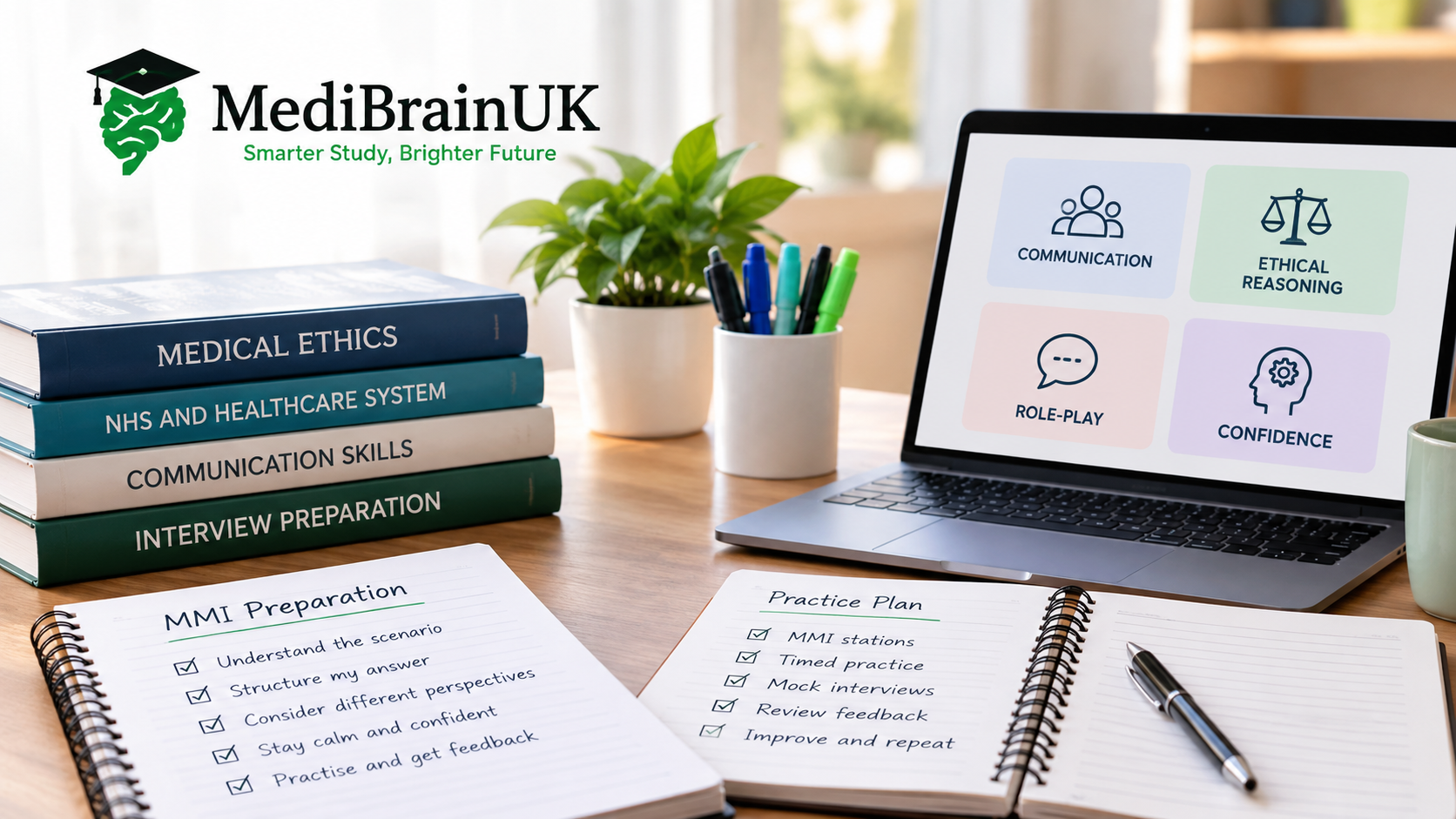
An MMI station can be over before you have fully settled into the chair. You may have only a short time to read a scenario, organise your thoughts and respond while an assessor observes not only what you say, but how you think.
Preparing for MMI stations therefore requires more than learning polished phrases or memorising model answers. You need a reliable way to organise your thoughts, communicate clearly and make sensible decisions when you are under pressure.
The strongest candidates are not necessarily those who sound the most rehearsed. They are usually the candidates who can remain composed, recognise the important issue in front of them and explain their reasoning in a thoughtful, safe and professional way.
What assessors look for in MMI answers
Every medical and dental school designs its own stations, timings and assessment criteria, so there is no single formula that guarantees a strong performance.
However, MMIs commonly assess qualities such as:
- communication
- professionalism
- ethical awareness
- empathy
- teamwork
- judgement
- reflection
- resilience
- awareness of personal limitations
A strong answer demonstrates these qualities rather than simply naming them.
In an ethics station, for example, an assessor is unlikely to be impressed because you can list autonomy, beneficence, non-maleficence and justice. What matters is whether you can recognise the competing concerns in the scenario and apply those principles appropriately.
Similarly, saying “I would show empathy” is much weaker than demonstrating what empathy would look like through the words you use, the questions you ask and the way you respond to another person's concerns.
Your answer should therefore have structure without sounding mechanical.
That balance is one of the central skills of MMI preparation.
Build frameworks, not scripts
Trying to memorise complete answers is one of the easiest ways to become stuck during an MMI.
The question may be worded differently from the one you practised. An actor may respond unexpectedly. The interviewer may interrupt you or ask a follow-up question that takes the discussion in another direction.
If your preparation depends on remembering exact wording, even a small change can disrupt your answer.
Instead, develop flexible frameworks for common station types.
A framework gives you somewhere to begin and helps you organise your reasoning, but still allows you to respond naturally to the scenario in front of you.
Ethics and professionalism stations
Start by identifying the central problem.
Ask yourself:
What is the main issue here?
It might involve confidentiality, consent, capacity, fairness, safeguarding, honesty, professional boundaries or patient safety.
Then consider the people involved and their different perspectives.
A patient, parent, healthcare professional, colleague or member of the public may each have legitimate concerns. A mature answer recognises these perspectives before reaching a conclusion.
Next, think about the competing principles.
For example, you may need to balance respect for a patient's wishes with concerns about preventing harm.
Finally, consider the safest and most appropriate next step.
As an applicant, you are not expected to manage a complex clinical or ethical situation independently. In many scenarios, recognising your limitations is part of demonstrating good judgement.
You might therefore explain that you would seek advice from an appropriate senior colleague, follow relevant guidance or policy and escalate concerns when patient safety or safeguarding requires it.
If the scenario involves a vulnerable person or a risk of serious harm, make this particularly clear.
Medical schools do not expect sixth-form students to know every detail of NHS policy. They do expect applicants to recognise when something is beyond their competence and when appropriate help should be sought.
Role-play and communication stations
Role-play stations test much more than whether you can deliver the "correct" information.
They examine how you interact with another person.
Your opening matters. Introduce yourself appropriately, maintain attentive body language and use a calm tone.
If someone is upset or angry, resist the temptation to immediately solve the problem.
First acknowledge what you have heard.
For example:
“I can understand why that situation has been frustrating for you.”
Then use open questions to understand the problem properly.
Listen to the response rather than simply waiting for your next opportunity to speak. Summarising what the person has told you can demonstrate that you have understood their concern.
Only then should you begin discussing possible options or next steps.
This sequence helps prevent one of the most common MMI mistakes: delivering a prepared speech when the station actually requires a conversation.
You may be asked to persuade someone, resolve a disagreement, explain an error or speak to somebody who is distressed.
You do not have to "win" the interaction.
Your aim is to communicate respectfully, understand the other person's perspective and work towards the safest reasonable outcome.
In many role-play stations, professionalism becomes most visible when the conversation becomes uncomfortable.
Motivation and reflection stations
Questions about why you want to study Medicine or Dentistry are not invitations to repeat your personal statement.
Assessors want to understand whether your motivation is informed, realistic and based on genuine exploration of the profession.
Use specific experiences, but concentrate on what you learned from them.
A care home placement, volunteering role, clinical observation or part-time job can all provide valuable evidence if you can explain what the experience taught you about communication, teamwork, responsibility or patient care.
Avoid presenting healthcare as an idealised profession without difficulties.
A thoughtful applicant recognises both the rewards and the pressures associated with a healthcare career.
For reflective questions, a simple structure works well:
What happened?
What did you learn?
What would you do differently next time?
The description of the event should usually be brief. The reflection is where the value lies.
Interviewers are generally more interested in what an experience changed about your thinking than in hearing every detail of what happened.
How to prepare MMI station answers under time pressure
Good content can still become ineffective if it is delivered too quickly, without structure or with little interaction with the interviewer.
Timed practice should therefore become an important part of your preparation once you understand the basic station frameworks.
Start with untimed practice.
Read a scenario, make a few brief notes and explain your reasoning aloud.
Listen for places where you:
- jump to conclusions
- repeat yourself
- spend too long describing the scenario
- make assumptions
- use vague statements
- forget to consider another person's perspective
Then gradually introduce realistic timings.
Station formats vary between universities, but you may have only a short period to read the instructions followed by several minutes to respond.
Practise the whole process: reading the scenario, identifying the central issue, entering the station, giving your opening response and handling follow-up questions.
A timer can tell you whether you finished within six minutes.
It cannot tell you whether you actually answered the question.
That is why good feedback matters.
After each station, identify one or two specific improvements.
Perhaps you need to signpost your reasoning earlier. Maybe you need to ask more open questions, acknowledge emotion before offering a solution or spend less time explaining background information.
Trying to correct ten weaknesses simultaneously usually makes practice less effective.
Targeted repetition is much more useful.
What to do when your mind goes blank
Interview nerves are normal, particularly when you know that several minutes of conversation may contribute to an important admissions decision.
Trying to eliminate every trace of nervousness is rarely realistic.
A better goal is to develop a response that still works when you feel nervous.
When you receive a difficult prompt, allow yourself a brief pause.
Then give yourself a structure.
You might say:
“I would first want to understand the patient's perspective, then consider whether there are any immediate safety concerns before deciding who should be involved.”
This does two things.
It gives the assessor a clear map of your reasoning, and it gives you a few valuable seconds to organise your thoughts.
For opinion-based stations, avoid treating your first instinct as the only reasonable position.
Recognise another perspective, explain your reasoning and then consider the practical consequences.
This is particularly useful for discussions involving NHS pressures, public health, social media, organ donation or allocation of limited healthcare resources.
If you genuinely do not know an important fact, do not invent one.
Explain how you would obtain reliable information or seek appropriate guidance.
In healthcare, recognising uncertainty and knowing when to ask for help can demonstrate stronger judgement than pretending to be certain.
Confidence is a skill that can be practised
There is an important difference between knowing how to answer an MMI question and being able to deliver that answer effectively when you are being assessed.
A student may understand ethical principles perfectly at home but struggle to organise them when a timer is running.
Another may have excellent work experience but rush through their reflection because they are nervous.
Some candidates speak too quickly. Others become very quiet, overthink their opening sentence or lose their train of thought after a challenging follow-up question.
This is why effective interview preparation should address both content and performance.
Confidence should not mean trying to appear fearless.
It means developing techniques that allow you to think and communicate effectively even when you feel some pressure.
Repeated exposure to realistic interview conditions can help. So can learning how to pause appropriately, control the pace of an answer, recover after losing your train of thought and move on after a station that did not go as well as expected.
These are trainable skills.
Why confidence coaching can complement MMI teaching
Traditional interview preparation understandably concentrates on what candidates should say.
But interview performance is also influenced by what happens when a candidate experiences pressure.
Nervousness can affect breathing, pace of speech, concentration, recall and body language. A candidate who knows the content may therefore perform below their normal ability simply because they have not practised managing the interview environment.
This is where structured confidence coaching can complement academic interview preparation.
Within MediBrain UK's Medical School Interview Preparation Programme, applicants receive structured MMI and panel interview teaching alongside five hours of confidence coaching delivered by experienced psychologists.
The purpose is not to provide psychological therapy or to remove normal interview nerves.
Instead, the coaching focuses on practical interview performance: understanding how pressure can influence communication, developing strategies for maintaining composure, building confidence through preparation and learning how to recover when an answer or station does not go as planned.
This distinction is important.
A candidate does not need to feel completely relaxed to perform well. They need to be able to function effectively despite feeling nervous.
Combining interview knowledge with realistic practice and confidence-focused preparation can therefore help bridge the gap between knowing what a good answer looks like and being able to deliver one under pressure.
Practise with feedback that reflects real admissions standards
Independent practice with friends or family can be useful, particularly when you are beginning to become comfortable speaking aloud.
But it has limitations.
Someone may tell you that an answer "sounds good" without noticing that you have failed to address the ethical conflict, missed a safeguarding concern or never actually answered the question.
Useful feedback needs to be specific.
You should understand:
- what you did well
- what was missing
- whether your reasoning was logical
- whether your communication was clear
- how effectively you responded to follow-up questions
- what you should change on your next attempt
It should also recognise that medical schools do not all interview in exactly the same way. Different medical and dental schools may place different emphasis on role-play, motivation, teamwork, ethical reasoning, data interpretation or situational judgement.
Within MediBrain UK's interview programme, candidates practise timed MMI stations and panel-style questions, receive feedback and work through the major themes likely to arise in medical and dental school interviews.
The programme also includes areas such as medical ethics, NHS topics, communication, role-play, motivation and university-specific preparation.
The aim is not to produce candidates who give identical answers.
In fact, that would defeat the purpose of good MMI preparation.
The aim is to help applicants develop frameworks strong enough to guide them but flexible enough to cope when an interviewer changes the question, challenges an assumption or asks an unexpected follow-up.
Practise recovering, not just answering
One of the most useful things you can practise before an MMI is recovery.
Candidates often spend weeks trying to produce perfect answers, but real interviews are rarely perfect.
You might forget a point.
You might misunderstand part of a question.
An actor might respond in a way you did not expect.
You may leave one station feeling that you performed badly.
The important skill is being able to reset.
If you lose your train of thought, pause, return to the central issue and continue.
If an interviewer challenges your position, do not automatically assume that your answer was wrong. Listen carefully and consider whether the new information should change your reasoning.
And when one station finishes, leave it there.
Carrying frustration from one station into the next can turn one difficult interaction into several weaker performances.
This ability to recover is one reason realistic mock practice is so valuable. You are not simply rehearsing answers; you are learning how you respond when an interview becomes unpredictable.
Common MMI mistakes to avoid
One of the most common mistakes is answering the question you expected rather than the question you were actually asked.
Read the prompt carefully, particularly the final instruction.
A station may ask:
What would you do first?
That is different from:
Discuss all the issues involved.
Another common mistake is overloading an answer with terminology.
Ethical principles, professional values and NHS concepts can strengthen your reasoning, but only when they are relevant and properly applied.
Plain English supported by clear reasoning is usually more convincing than a string of technical labels.
Candidates should also avoid sounding excessively certain when a scenario is genuinely complex.
Statements such as “I would definitely…” can sometimes close down the discussion too early.
Phrases such as “I would first want to understand…”, “I would need to consider…” and “If there were concerns about safety, I would…” often demonstrate more mature reasoning.
Finally, remember the interpersonal side of the station.
Looking down at the prompt throughout the conversation, interrupting an actor, speaking too quickly or failing to acknowledge somebody's emotions can weaken an otherwise intelligent response.
Treat every station as a professional interaction rather than a speech competition.
A practical MMI preparation routine
A useful practice cycle is:
1. Understand the station type
Identify what the station is actually testing.
2. Build a framework
Know the key stages of your reasoning rather than memorising sentences.
3. Practise untimed
Concentrate initially on the quality of your thinking.
4. Add realistic timing
Learn to organise the same reasoning when time is limited.
5. Introduce follow-up questions
Do not practise only predictable scenarios.
6. Get specific feedback
Identify one or two changes for the next attempt.
7. Repeat the station
Apply the feedback immediately rather than simply moving to another question.
8. Practise recovery
Include difficult or unexpected questions so that you become comfortable regaining your structure.
This final stage is particularly important.
Confidence rarely comes from reading more model answers.
It usually develops when you have repeatedly experienced difficult questions, worked through them and discovered that you can still produce a sensible response.
Final thoughts
Preparing for an MMI is not about creating the perfect answer to every possible question.
That is impossible, and attempting it can make candidates sound more rehearsed rather than more prepared.
Instead, build reliable frameworks. Understand the principles behind your decisions. Practise communicating with another person rather than delivering speeches. Get specific feedback. Gradually introduce realistic time pressure and learn how to recover when something unexpected happens.
Most importantly, separate confidence from perfection.
You do not need to enter every station without nerves. You need enough structure, practice and self-control to think clearly despite them.
A strong MMI candidate is not someone who has memorised every answer.
It is someone who can listen carefully, recognise what matters, communicate with empathy, explain their reasoning and remain safe and professional when the station does not go exactly as planned.