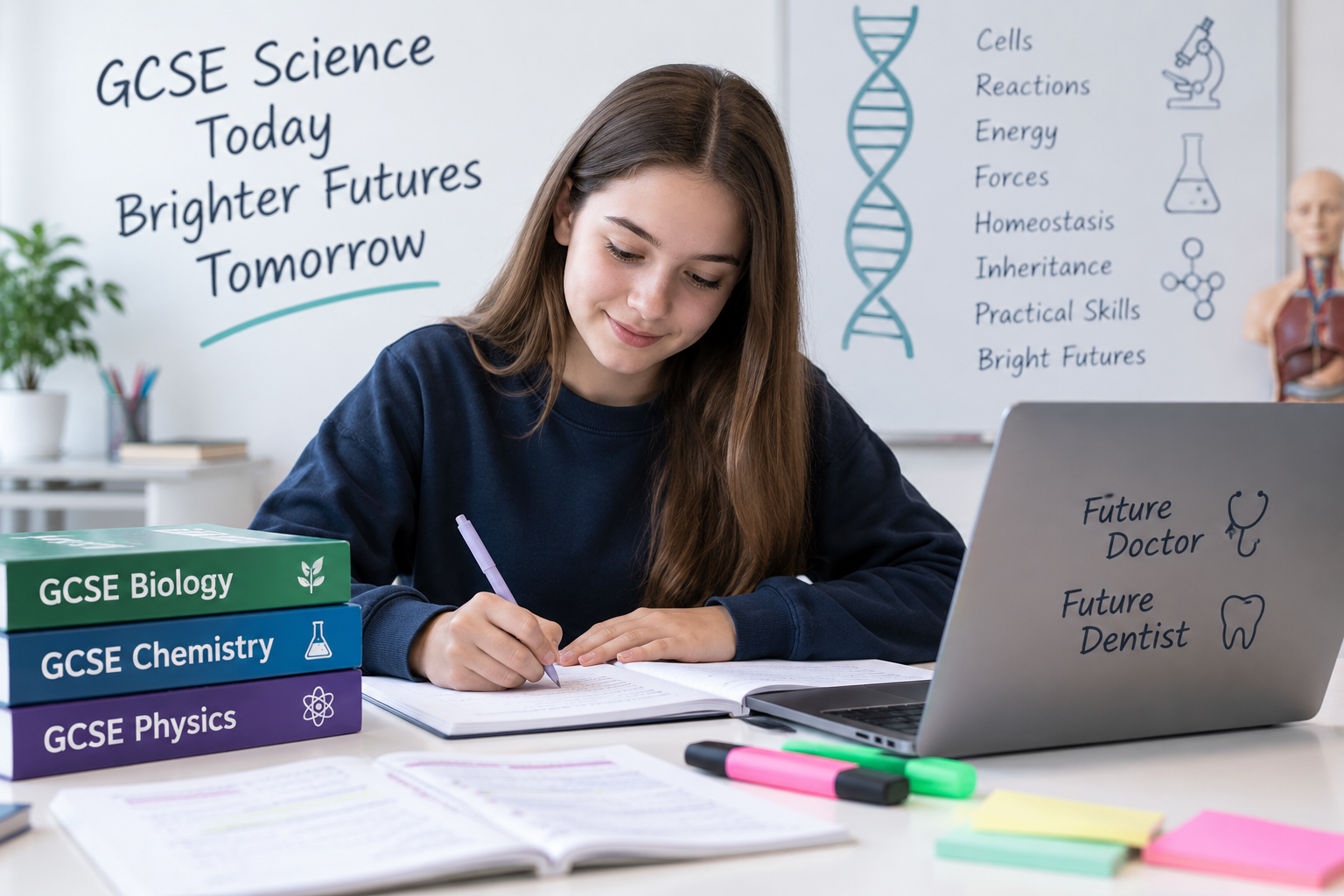
GCSEs are not the whole medical or dental school application, and entry policies differ between universities. However, strong GCSE performance can matter, particularly where medical or dental schools use GCSEs in shortlisting or expect high grades in English Language, Mathematics and the sciences. More immediately, the habits developed now shape how confidently a student approaches Biology and Chemistry at sixth form.
Why GCSE science matters for aspiring medics
Medicine and Dentistry are science-led degrees, but they also demand accuracy, consistency and clear reasoning. GCSE Combined Science or separate sciences introduce many of the foundations that students will revisit in greater depth: cells and infection, bonding and reactions, energy transfers, forces, homeostasis, inheritance and required practical work.
The value of doing well is not just the grade on results day. A student who understands why an enzyme changes shape when exposed to high temperatures, rather than simply memorising a sentence about denaturing, has a more secure foundation for A-Level Biology. A student who can rearrange equations calmly and use standard form accurately is better prepared for the quantitative elements of Chemistry and Physics.
A strong GCSE profile also sends a wider message. Medical and dental applications are competitive, and universities need evidence that applicants can manage sustained academic pressure alongside multiple commitments. GCSEs offer an early opportunity to establish reliable study systems before A-Levels, work experience, UCAT preparation and application deadlines begin competing for attention.
That said, a student does not need to have their entire career decided at 14 or 15. Effective tuition should strengthen options, not create unnecessary pressure. The focus should be on becoming scientifically capable, organised and confident enough to choose the next stage from a position of strength.
What effective GCSE science tuition should address
A productive tuition programme starts with diagnosis. Two students may both be working at grade 6 yet need completely different support. One may understand the content but lose marks through vague extended answers. Another may know the mark-scheme language but have gaps in core calculations. A third may be capable in class but struggle to revise independently between assessments.
The strongest GCSE science tuition brings these areas together rather than treating every lesson as a walkthrough of the textbook. It should identify the exam board, specification and tier, then map weaknesses against the exact knowledge and skills being assessed. This matters because a generic lesson on electrolysis or the circulatory system can feel useful without resolving the precise issue holding a student back.
Secure the knowledge before chasing past papers
Past papers are essential, but they cannot replace subject knowledge. Students need to understand the scientific story behind a topic before practising how to express it under timed conditions. In Biology, this may mean linking structure to function rather than memorising isolated definitions. In Chemistry, it may mean tracing particles and charges through an equation. In Physics, it often means translating a written scenario into the correct quantities, equation and units.
A tutor can check understanding through targeted questioning and short retrieval tasks. This is more revealing than asking, ‘Do you understand?’ A student may feel familiar with a topic after reading notes, but familiarity is not the same as being able to explain it without prompts.
Teach the method that earns marks
High-scoring science answers are precise. Students should learn to notice command words, select the detail a question requires and avoid adding inaccurate statements in an attempt to say more. ‘Describe’, ‘explain’, ‘compare’ and ‘evaluate’ each demand a different type of response.
Required practicals deserve particular attention. These questions test more than whether a student remembers the equipment. Students may need to explain a control variable, justify repeat readings, identify a safety risk, calculate a mean or comment on anomalous results. These are transferable scientific skills and common areas in which avoidable marks are lost.
Calculations need regular, low-pressure practice rather than a last-minute revision burst. Students should become comfortable with equation sheets, substituting values, rearranging formulae, units, prefixes and significant figures. In many cases, the science is understood, but the final answer loses a mark because the unit is missing or the power of ten is incorrect.
Build independent revision habits
One-to-one support is valuable, but its purpose is not to make a student dependent on a tutor. A good programme gives students a manageable plan for the days between sessions: what to retrieve, which questions to attempt, how to correct errors and when to return to older topics.
For GCSE science, short, frequent retrieval is usually more effective than rereading large sections of a revision guide. A student might review key definitions, draw a process from memory, complete a few calculation questions and correct one previous error. The method must be realistic alongside schoolwork and other subjects. An overambitious timetable that is abandoned after three days does not build confidence.
When should students start tuition?
The best time depends on the student’s starting point and goal. Year 10 is often an excellent time to strengthen foundations before the content and assessments intensify. There is enough space to correct misconceptions without every session feeling like an emergency. Students aiming for separate sciences, higher-tier papers or highly competitive sixth-form pathways may benefit from this earlier, measured approach.
Year 11 tuition can still make a significant difference, especially when it is focused. At this stage, support should prioritise the highest-impact gaps, exam technique and a clear revision cycle. It is rarely sensible to try to relearn every topic in equal depth a few weeks before mocks or final exams. A diagnostic assessment helps determine where time will deliver the greatest return.
Parents should be cautious of promises that tuition can guarantee a particular grade. Progress depends on attendance, the work completed between sessions, school teaching, starting knowledge and exam performance. The right tutor provides structure, feedback and accountability, while the student remains an active part of the process.
How to choose GCSE science tuition
Look beyond broad claims of ‘expert tuition’. A suitable tutor should know the GCSE specifications and be able to explain how sessions will be tailored to the student. Ask how they assess starting points, track progress and teach exam technique alongside content.
For students interested in Medicine or Dentistry, it can be useful to work with mentors who understand the longer academic journey. They can set high standards without making GCSEs feel like an admissions audition. Recent medical students and clinicians can also make the relevance of scientific study more tangible by connecting classroom topics to future patient care while keeping the immediate goal clear: performing well in the next assessment.
At MediBrain UK, GCSE tuition is designed as part of a longer academic foundation, with structured support that helps ambitious students prepare for A-Level sciences and the pathway ahead. The aim is calm, consistent progress rather than panic-driven revision.
Compatibility matters too. Some students respond best to a highly structured weekly plan; others need to rebuild their confidence after a disappointing mock result. The tutor should be encouraging but direct, willing to challenge weak answers and explain exactly how to improve them. Clear feedback is more useful than repeated reassurance.
A practical approach from now to exam season
Start by gathering the specification, recent school assessments and any marked past-paper questions. These reveal patterns quickly. Are errors clustered in a topic such as quantitative Chemistry? Are marks being lost on evaluation questions? Does the student run out of time or leave calculations blank?
Use that evidence to set a small number of priorities for each fortnight. One block might focus on Biology required practicals and extended responses; the next could target Physics equations and electricity. Keep a record of recurring errors and revisit them deliberately. Improvement is not measured only by scores. It is also visible when a student can identify what a question is asking, select an approach and explain their reasoning with less hesitation.
As exams get closer, timed practice should become more regular. Mark answers carefully against the available marks, then use corrections as revision material. The goal is not to memorise every mark-scheme phrase. It is to develop the accurate, economical scientific communication that mark schemes reward.
A strong GCSE science result begins with the next focused session, not a perfect revision plan. Build the knowledge properly, practise in the way exams demand and keep moving forward one corrected mistake at a time.